


The aesthetic of water
 Photograph of Adèle Charbonnier
Consolidation of some initial ideas
The aesthetic of water
Condensing some initial ideas
Despite the proposal being to talk and reflect on the aesthetic dispute we’ve been engaged in since Concomitentes, we ended up talking about something else. About chairs fixed with wire. About dry stone walls. About the magic of clearing undergrowth. About the work of master craftswomen and builders in our village.
The discussion proposed as part of the first get-together of 2026 was very enriching for the mediators. We exchanged texts, insights, and possible lines of work. What wasn't so obvious was that this harmless proposal would lead me, for the first time, at least explicitly, to ask the clients of “Clearer Than Water” a seemingly simple question: what is the aesthetic that surrounds you?
To be able to ask ourselves what we want to contest, we first needed to look carefully at where we are. And doing so through an aesthetic lens has been, surprisingly, pleasurable. Even fun. But above all, it has opened a crack, another way of looking at the territory, of reading it, of letting it speak to us, which I suspect has come to stay.
In Sapeira, the Pre-Pyrenean village where this confluence unfolds, there's one thing that becomes immediately apparent. Not as an idea, but as an evidence: the relationship with the surroundings. Here, everything around you tries to tell you that the separation between nature and culture is a fallacy. The wall never quite remains just a wall. The fig tree intrudes, the boundary yields, the stone is displaced and repositioned, and human and non-human life flows between one thing and the other. The people here have developed a kind of refined gaze to navigate this continuity. To distinguish without entirely separating. To know where one thing ends and another begins, but without the need to fix it.
The landscape is not a backdrop. The orchards, the paths, the fountains, are part of everyday life. And the constructions do not impose themselves: they adapt in form and materials. There is an “aesthetic” of integration, of coexistence between species, which does not eliminate conflict, but rather makes it liveable. And which reminds you, almost daily, that interdependence, even between species, is not a discourse, but a material condition. And if we look up and look a little further, we see it again as we cross the valley drawn with a rare mosaic landscape.
This relationship with the environment is not abstract. It is made concrete in dry stone walls, in cobbled paths, in solutions that respond not to manuals but to specific uses. These are forms that speak of the past and the future, at the same time, responding to a logic of adaptation centuries old, and at the same time, hinting at the disappearance of knowledge linked to the maintenance and crafts of the mountains. What is often perceived today as a desirable aesthetic, especially by those who come from outside to spend the day or the weekend, is the trace of knowledge at risk of disappearing.
And yet, none of this is pure. Stone coexists with mortar, concrete, and bricks. Ancient solutions with lessons that some neighbours learned in larger towns or cities when they had to move. And in this constant mixing, what appears is not a “traditional” aesthetic, but something else: that of communal work. Here, many infrastructures have no author. Or they have too many. They don't respond to a signature, but to hands that have gradually been added.
This lack of authorship displaces the idea of a “work” and places value on use, functionality, and shared life or the aforementioned interdependence. This is why we talk about and champion "communal luxury," where aesthetics are not built from exceptionalism, but from the continuity of shared making. Easy, repeated, sustained, and transformative works, done by many hands over a long period of time. And which, almost without you realising it, end up shaping an entire valley. There's a paradox here. The common, or the "cumó," as communal work is called here, erases authorship. But at the same time, it returns you as an individual within the collective, something unusual: the learning that you can intervene in your environment. A process of empowerment, as an agent, or author, of change.
There is also another layer, more discreet, perhaps. That of repair. The town is full of small interventions, adjustments, patches, and provisional solutions that end up being permanent. Maintenance takes centre stage, and with it a way of producing reality in a sustained manner, without spectacularity and profoundly political.
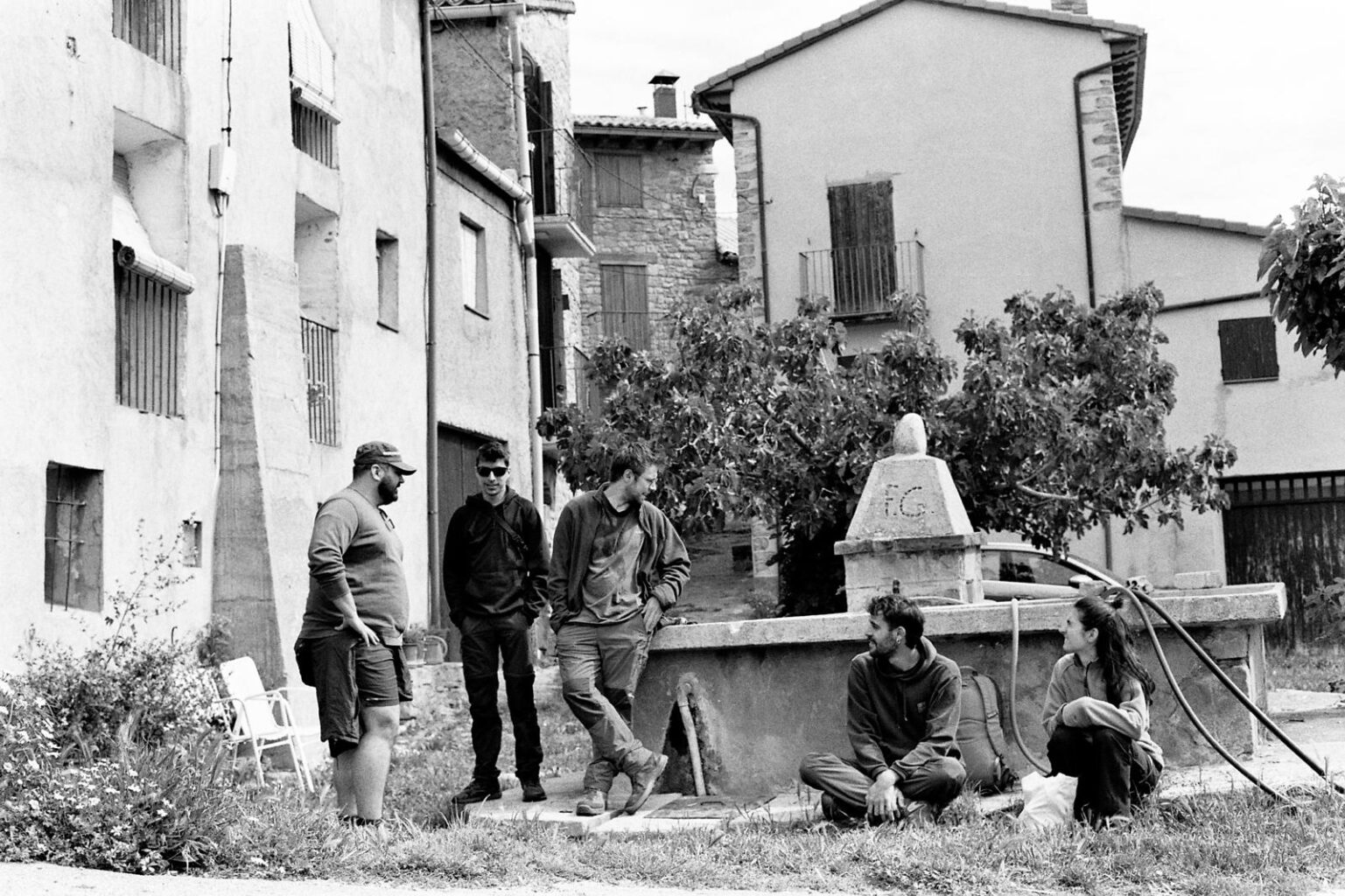
Between this communal doing and this logic of arrangement, authorship does appear from time to time. But when it does, it has little to do with the figure of the artist, and more with that of the craftswoman. With gestures that, without ceasing to be useful, allow for a bit of play. And then we think of that mason who, upon finishing the washbasin, decided to leave his initials and the year, drawn with river stones on the cement, and probably because it had turned out fabulously, decided furthermore to crown the fountain with a rock that could be an Easter egg. And we laugh. Perhaps because in these gestures there is something that bridges the gap: between utility and whim, between the everyday and posterity, between spectacularity and the common, which is a synonym for 'balsa' in Catalan, incidentally.
And here we are, for the moment. With the feeling of having opened a door. Of having started to read the place in a different way. From here, the question returns: what is the place of our concomitance? If all aesthetics is a stance, what is ours? For it seems that “Clearer than Water” works and proposes an aesthetic of the relational, perhaps unspectacular but deeply situated. A continuist aesthetic, in short, that does not focus on the final object, but on the links that make it possible, in this case those that have made a way of seeing and living water possible.




 Concomitentes