

Concomitentes measures the impact of its projects
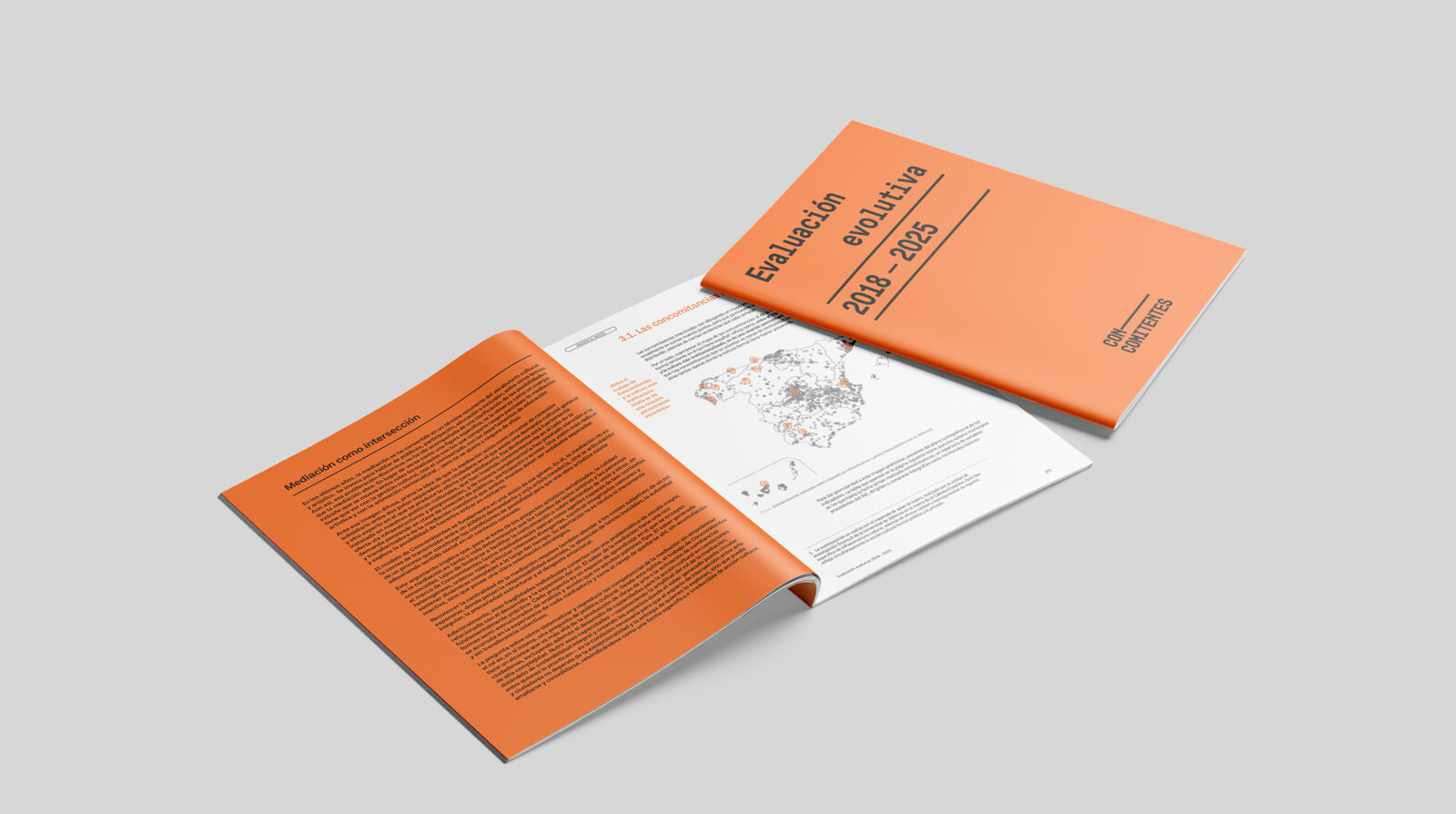 Mockup of the publication.
We present "Evolutionary Evaluation 2018-2025", a report to understand the impacts of Concomitants
How can we assess the value generated by participatory art? How can we measure the impact of processes that connect artistic creation with the lives of communities? With these questions as a starting point, in Concomitentes we present our Evolutionary Evaluation 2018-2025, a report prepared by Culturalink that analyzes our trajectory, our ways of doing things, and the value that the coincidences generate.
We understand concomitances as participatory artistic processes in which citizens, mediators and artists work together around a shared problem. They are long processes, characterized by listening, negotiation and collective construction, that culminate in works of art linked to the desires, experiences and needs of the communities that drive them.
Sometimes, the emotion that arises at the opening of a work allows us to intuit the strength of that shared journey. But how can we make visible everything that happens before, during, and after? How can we understand the connections that are being built, the learnings that are taking place, and the ability of these processes to strengthen citizen agency?
Evaluate to understand, not to supervise
Cultural assessment often relies on tools that do not always allow for recognizing the complexity of participatory processes. Measuring results or quantifying impacts can leave out fundamental aspects of the cultural experience: unexpected changes, the relationships that emerge, the debates that open up, or the collective capacities that develop.
Therefore, this evaluation proposes a multidimensional and processual view of value, which goes beyond final results to explore how and under what conditions it is generated. It does not seek to establish a universal formula for measuring participatory art; rather, it develops tools that allow for a better understanding of its particularities and makes visible dimensions that often fall outside conventional evaluation frameworks.
The report reconstructs and analyzes the period 2018-2025 based on documentation of the projects, internal data from Concomitantes, questionnaires addressed to committee members, artists and mediators, and in-depth interviews.
An evaluation that also transforms our way of working
Among the results, The report highlights how citizen participation can enrich artistic practice. The data collected point to a central idea: participation does not have to limit artistic creation. When there is appropriate mediation, dialogue with communities can expand their possibilities, transform practices, and challenge conventions about what constitutes a work of art, how it is created, and who it belongs to.
Regarding the impacts of the projects, the three dimensions of value evaluated—Experiential, Democratic y systemic—the results are in the high or medium-high range, which confirms that the concomitants generate real and multidimensional value.
A starting point to keep learning
The evaluation also acknowledges its own limitations: the lack of face-to-face fieldwork, the unequal representation of responses, and the absence of some peripheral voices in the processes invite further refinement of the analytical tools. Far from closing the debate, the Culturalink report opens up new questions and points the way forward for continued learning.
Thus, the Evolutionary Evaluation 2018-2025 This is not just an overview of the trajectory of Concomitentes, but a starting point for developing a protocol of continuous evaluation that allows us to systematically observe how our organization’s work evolves and the value it generates at its different stages.
Our goal is for the evaluation to function as a tool for collective learning: a way to better understand what we do, recognize its effects, and improve our processes.



 Concomitentes
