

Searching for fossils
First of the stories that make up the mediation path initiated with the project.
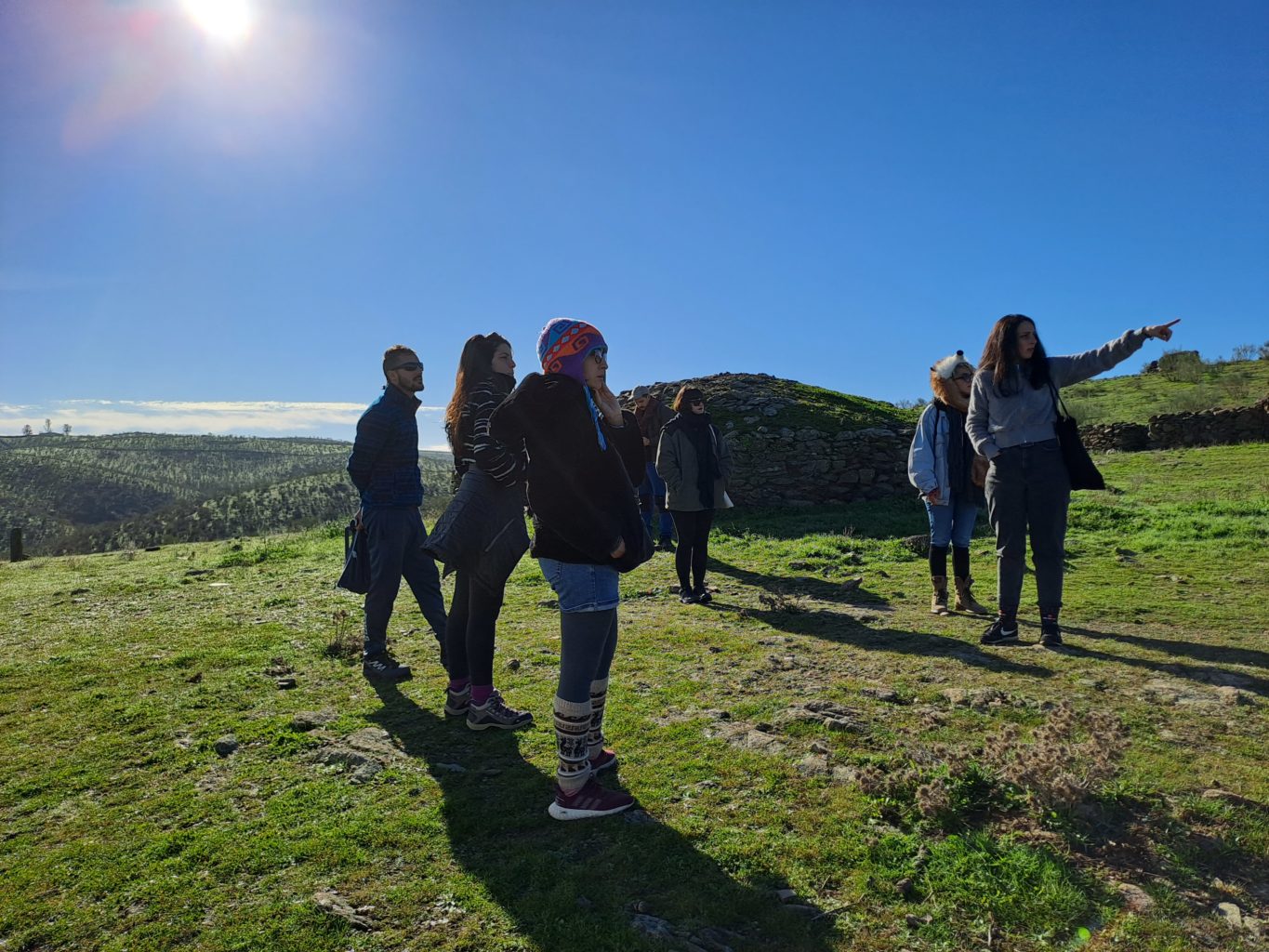
In one of the first outings of ‘Non plus ultra’, we visited the huts and zahurdas of Llera, in the north of the Campiña Sur region. It was a sunny winter morning, the last of the December rains had greened the countryside and the stone buildings stood silently among the steep hills on the border with Tierra de Barros, where the olive groves give way to the dehesas. From there, we could intuit the Molinos de Matachel reservoir, or the place where it should be, flowing from the Sierra de Hornachos, which we had in front of us. A while later we found that the reservoir was in a critical situation, with some areas dry for months, maybe even a couple of years, and a jetty for small boats stranded in the middle of the field.
The huts of Llera in the estate “Las Mil y Quinientas” have been declared an Asset of Cultural Interest and are one of the outstanding examples in the designation of dry stone construction as Intangible Cultural Heritage of Humanity. The trigger to approach us had been given in one of the last meetings of the group in which the question arose about which fossils we want to leave as individuals, as a group, as a generation... Thinking from the fossil and not from the ruin led us to possible sources of energy, materials that can be transformed in the future in ways we cannot yet imagine to generate or activate other things.
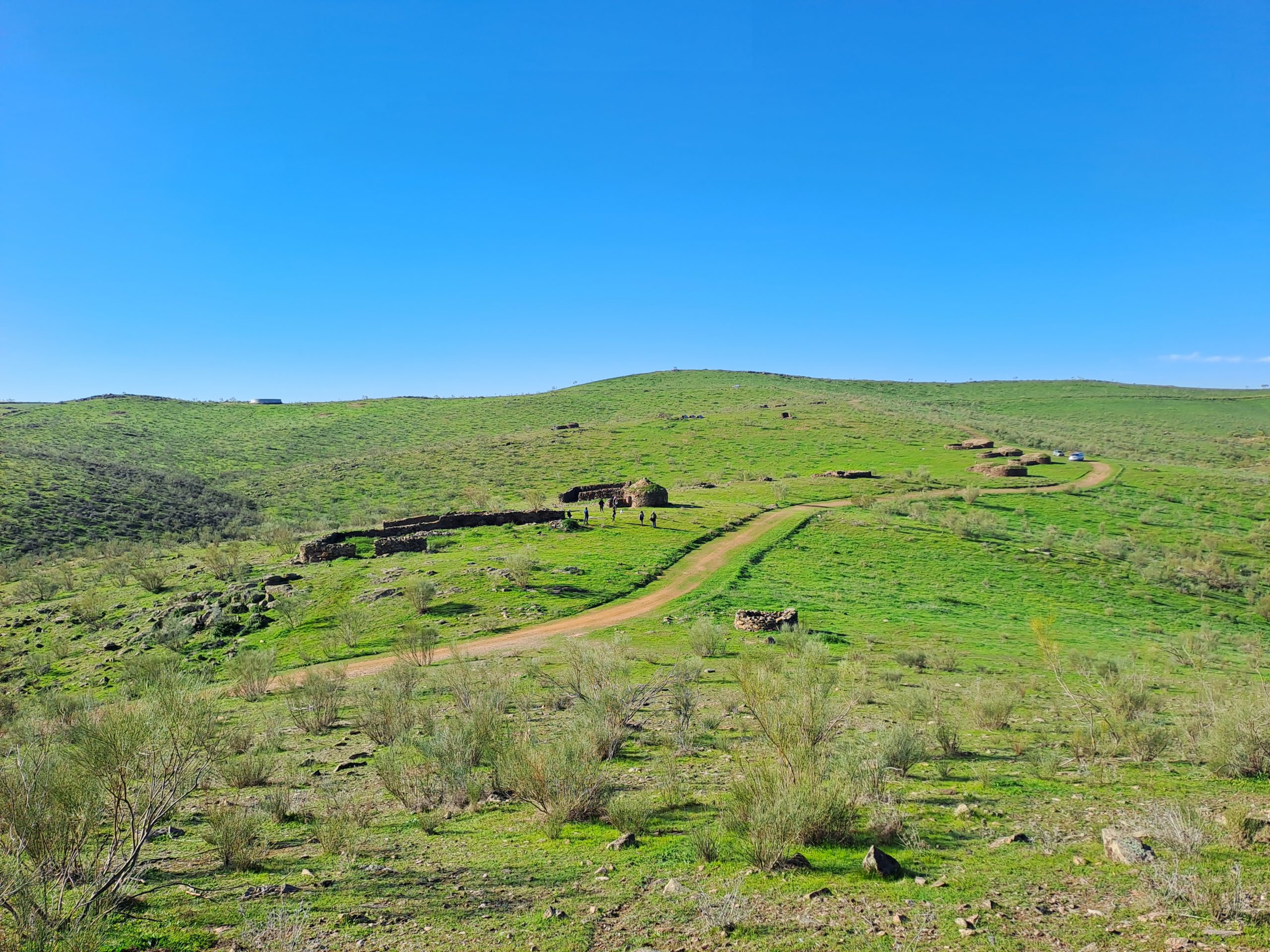
The huts of Llera have a telluric beauty. My first sensation was that they were Palaeolithic constructions, very ancient: built only with stones, with a circular base, low entrances that make you bend down as if you were entering a cave. It was just a prejudice because of the disconnection with the peasant culture that used them until very recently. These huts ceased to be used 4 or 5 decades ago, huts in other places maybe much less, maybe some are still in use. Visiting them - under the guidance of our colleague María, who was familiar with both their use and their recovery as a heritage site a few years ago - was a way of life and a way of relating to the territory that was radically different to ours, to that of the group of people who had been there, but very close in time. A hard way of life, marked by the violence of the latifundia structures, but full of experiences and knowledge that cannot be forgotten. and cross out “as one who draws a line through a settled account” (John Berger).
We had started thinking about and looking for fossils - in the more traditional sense - on a previous outing. Speaking of droughts and waters, our colleague Juan had pointed out that on the outskirts of Los Santos de Maimona there were some hills where specimens of marine fossils could easily be found, a trace of the waters that inhabited this territory millions of years ago. It was not difficult to find some rocks where we could distinguish signs of snails or plants. Once we learned to distinguish them we saw them everywhere, the rocks were populated by the shadow of an exotic ecosystem. We were on top of a hill overlooking a small valley through which the Robledillo stream flows, a soil that we tried to imagine as it had been shaped during the Carboniferous period, more than 300 million years ago - our knowledge was based only on a quick Wikipedia search. On the other side of the valley, a little lower than the point from where we were looking down, there was a brick chimney, the remains of an old coal mine that had not been exploited for decades, perhaps even longer than the huts of Llera. The coal that was exploited there and the fossils that we found there have their origin in the same period. The chimney looked like a ruin, the vegetal marks on the rock like fossils. The difference may lie in the ability of fossils to escape from a linear temporality where the past is left behind, they connect us to energy transfers, linking us to distant worlds that are not necessarily finished.
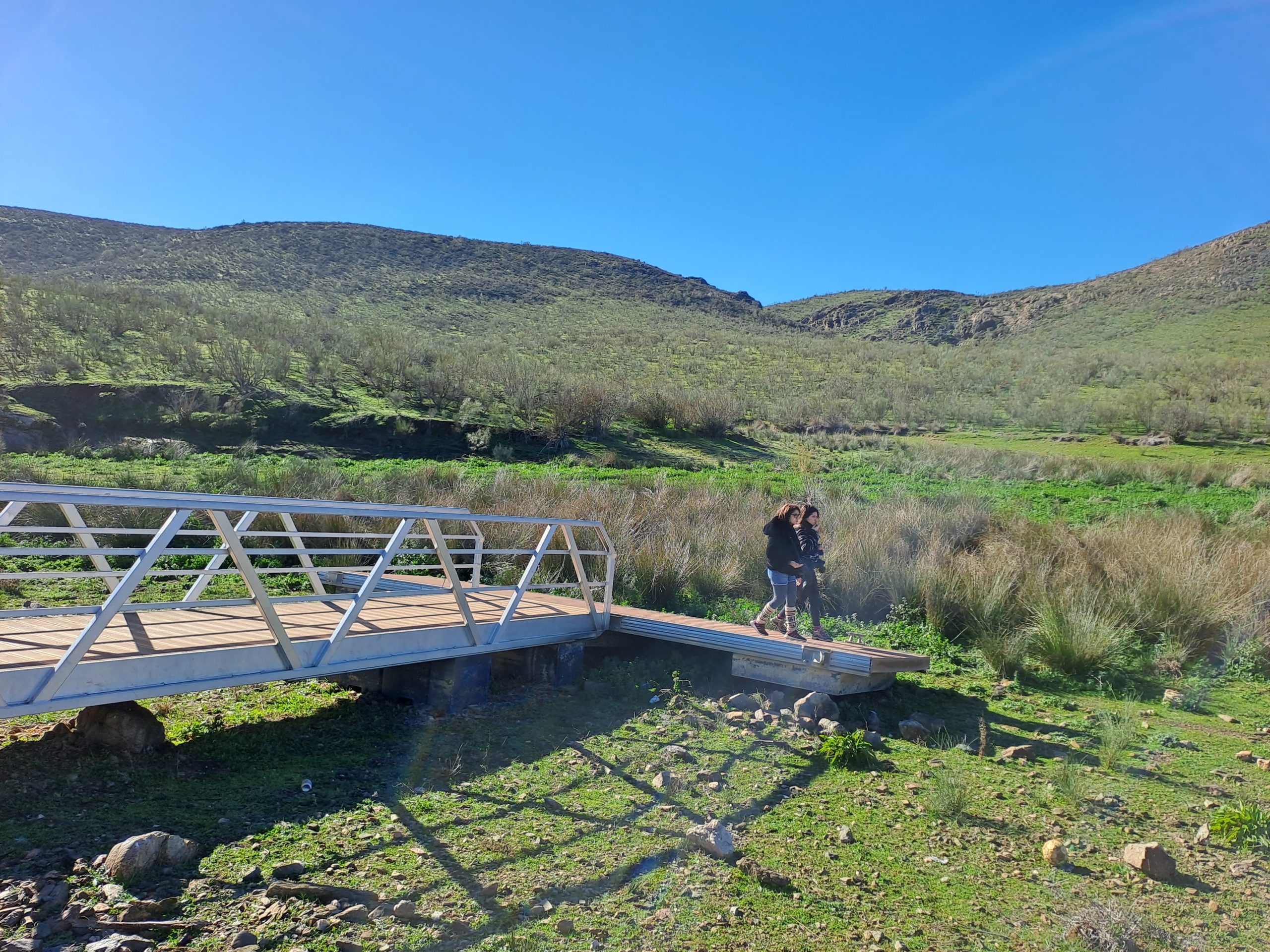
The visit to Llera - I continue to see the state of sources that have lost their function as a meeting space - shook up our notion of common time. It did not make it easier to specify anything, but it made a multiplicity of time scales emerge and the possibility of redefining terms such as “future”, “fossil”, “inheritance” or “future”.
The fossils, both those of the Carboniferous period and the huts of Llera observed under this lens, generated vibrations in our way of perceiving time. Their geological materiality and their different scales - the proximity of the families that inhabited these huts, the brutal distance of minerals of vegetable origin - question our perception of the place we occupy, they open up questions: What does it tell us about the notion of progress, from the precariousness that now makes it difficult for us to inhabit rural areas, to visit huts that were used until so recently? What is the future on the scale of carboniferous fossils and what is it compared to the image of the dry reservoir and the stranded jetty? Towards what time frame do we want to project the commissioning of ‘Non plus ultra’? Do we want to do something ephemeral or do we want it to last? And if we want it to last, on what scale?