

A miña ávoa durmiu nas árbores, or the story of the Walking Day in Betanzos
Report of the walking day in Betanzos.
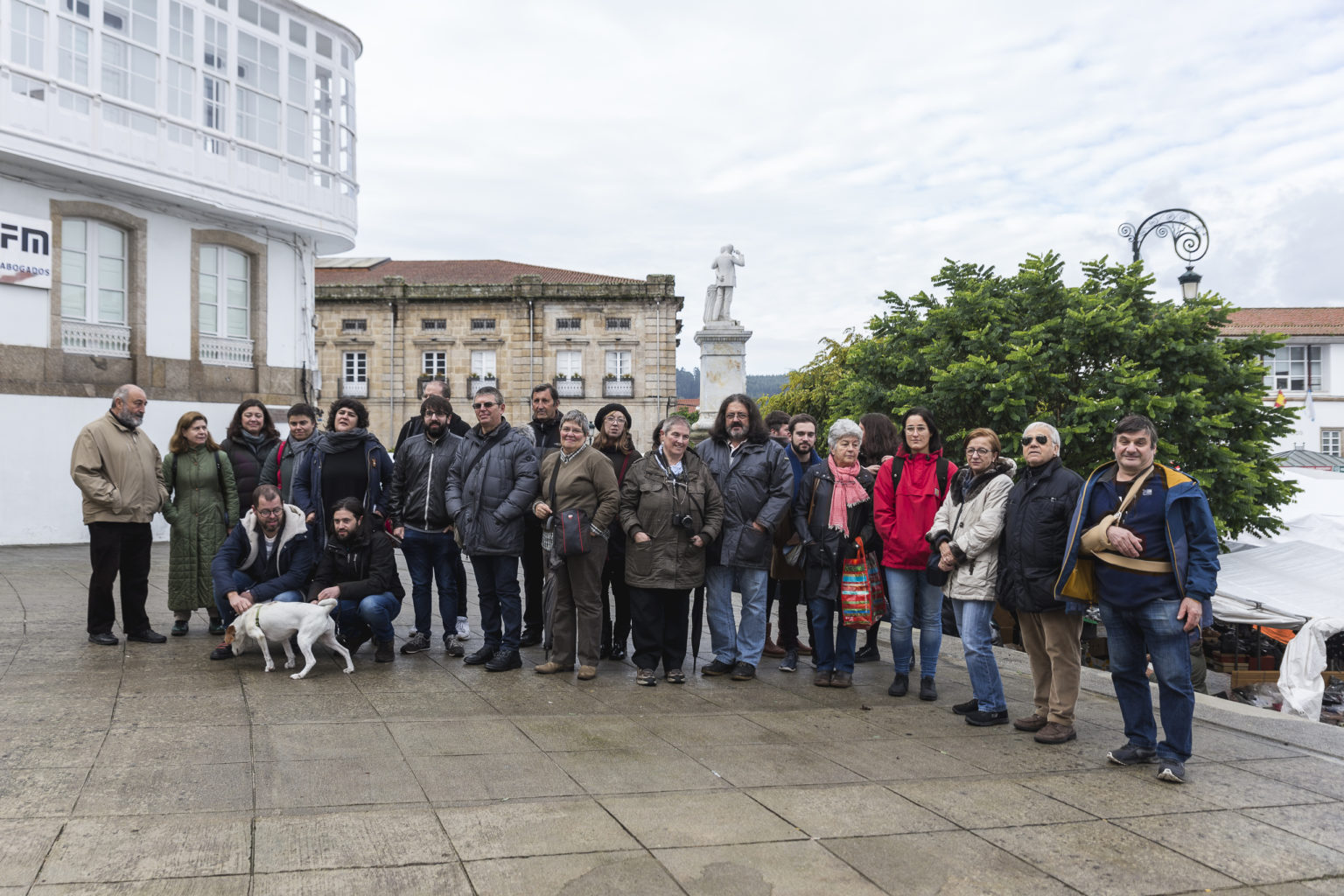
The weather abated on Saturday 16 in the morning in Betanzos. The square of the irmáns García Naveira, which is still known as the Campo, was covered with a sea of white tiles, under which, in apparent chaos, the fairs of the 1st and 16th of each month took place. At the church of Santo Domingo, on the hill, we gathered around thirty people and began the day's walk.
The proposal of Concomitentes in Betanzos is an invitation to dialogue and it is going to introduce those pedagogies of encounter with which to facilitate conversations.. On this occasion, the methodology consisted of walking while talking: a practice that is based on the Zapatista movement's "walking while asking" or the situationists' "walking while walking", and which is an adaptation of the one used by Andrea Olmedo and Fran Quiroga in the framework of experimental research. Ruraldecolonised which was held at MUSAC's Laboratorio 987 and the CGAC in 2016 and 2017. Who speaks and who is chosen? This tension is what determines the breadth of the proposals and proposals that are opening up new frameworks for participation.
Calling for dialogue is a manifestation of commitment, it is a pedagogy of care with which to open processes of interaction and not only as a space from which to weave that collective intelligence but also as a place for meeting.Fran Quiroga, the mediator of Concomitentes presented the dynamics through which we try to bring out the ideas for the definition of the commission to the artist. A “walking together” through the town of Betanzos where a series of stops and questions would trigger a collective debate about the legacy of the García Naveira family.. The schools, the washing place and finally the park of the pasatempo were the three points of a route spoken and crossed by the axes on which the project is based: a heritage with which the town feels identified and that expands to project it in the XXI century, the relations with the migrations and the recovery of a public space.
Andrea Rico, facilitator of the Rexenerando cooperative, asked the first question: Why were they there and what made them come to the territory? The groups organised in groups of four or five people left the fairgrounds to go down to the banks of the river Mendo talking about this and many other issues already related to the same subject. The first stop was the Lavadoiro, a whitewashed building from the beginning of the 20th century, two floors high. This construction, financed by the patrons of the Betancourt, is still in use more than a century later and in the summer, the clotheslines are still used by the locals. In its day, the washhouse was a place of collective empowerment for the women of Betanzos, which also functioned as a nursery and meeting point.
In its interior took place the first common position, where different voices were chosen. Some of them were there to reclaim the heritage value of their village or to support initiatives that take place in the village and create community, or because they saw the community as a space to create great changes from the smallest to the biggest, and some of the people who accompanied us remembered when they were cleaning their daughter's clothes more than forty years ago and mentioned how much the washing machine improved their lives. We were also accompanied by Carmen and Jose Luis, from the architecture team that rehabilitated the washing machine, who reminded us of the care that the García Naveira family took in their philanthropic works, who did not limit themselves to making a washing machine for their own use, se nón que crearon un “palacete” e apuntaban como proposta para a futura obra contemporánea, que se os irmáns foran quen de respostar aos retos os que se enfrontaba a sociedade da aquel tempo, non deberamos nos facer o mesmo, e ser quen de atender a reto contemporáneo?
In addition to this sharing, at this first stop we had the intervention of the poet and storyteller Enma Pedreira, who has just received the 11th Jules Verne Award for Young People's Literature with her work ‘Os corpos invisibles” (The Invisible Bodies). The twice winner of the prestigious Fiz Vergara Vilariño poetry prize, she also introduced, in a space essentially dedicated to the memory of Betancourt women, the question of gender and the power of building affective bonds through space. Through her intervention, she vindicated the need to revert the stories that have been forgotten and made invisible, those that have been buried because of the hexemonic stories. Her aunt, abandoned in the town of Betanzos at the age of eight, slept in the trees. Personal memories have a lot to do with fiction, and perhaps this was another example, but at the time the poet realised that the trees her aunt spoke of were a set of hedges with myrtles and bushes that simulated Don Juan's bedroom. O espazo público (privado daquela) está cheo de pequenas historias de vidas que alteran e modifican os usos do lugar, aí é onde está a potencia de pensar o espazo público.. Poetry is words, but also bodies that write them, feel them and recite them. We leave you here a fragment of the poet's intervention: https://soundcloud.com/user-533698698/z0000037.
From the ruin as beauty, from the river, from the river, from the return, and from the rock we missed Enma. This first stop on the route opened a new path towards the Pasatempo park, following the course of the river towards the second stop, in the old enclosure of the Pasatempo park, today reconverted as a public space and profoundly transformed. Once again, the groups had a question with which to trigger the debate, already begun in the wash itself, which was: if you were an artist, how would you contribute to dialogue with this legacy?
Under the footbridge that runs through the park we join together and make a new return to the group. From intervening in the footbridge itself, to transform it into an exhibition hall due to its lack of use, or to recover the productive and agricultural value that the park once had. Other ideas, much more immaterial, also appealed to the historical dimension, to the return of a time and voices that should be preserved with the creation of a sound archive or to bring to light the poetry that is engraved on the walls of the town.. Of the need to seek the overflow of the project, of how the intervention can evolve, mutate into another manifestation. Finally, with a more vindictive character and also with a more ethereal dimension, the idea of working the bodies and converting them into a protest that allows to redirect the high road traffic that, today, disconnects the different parts of the park from the pasatempo.
Xa coa choiva presente, recollidos baixo o teito da pasarela, e a modo de rocho, we hack o espazo, converting it into a space to project the intervention of Professor José María Cardesín, historian and professor at the University of A Coruña and coordinator of the Group of Territorial Studies. With him we approach the park in a different way. A park that had an educational and leisure vocation for an incipient middle and working class.
With him, we can remember the Universal Exposition of Paris, Bologna, Rome and other places that the irmáns García Naveira visited and that served as inspiration to create a whole ecosystem of actions at the service of the improvement of the community and the territory in which they were born. Technology and progress dominate the story, there was a clear teleological intention to improve humanity. If the people of Madrid have the Retiro, why shouldn't Betanzos have its own, hence the Retiro pond is part of the Pasatempo, as the professor pointed out.
The diversity of nature, technology, means of communication and locomotion in the park is intended to be illustrative.
Os fusos horarios, con centro en Bos Aires, dinos, tal e como sinalou o investigador, que “Galicia is wonderful, but it does not have all the answers, the answers have to be scattered all over the planet”.”. Thanks to the park, thousands of people were able to gain access to knowledge of all kinds: zoology, mythology or geography... Progressive education would change the world...
We returned to the square where, three hours earlier, the day had begun. This time the question was imagining the future, what would a park like the one at Pasatempo be like in the 21st century? On arriving, the fair had finished and what was once a sea of white awnings now revealed the metallic structures that support them. The music box hosted the last common position where the need for artistic intervention to be capable of reverting/addressing certain “evils” of our contemporaneity was highlighted. It was pointed out that this should be a space free of digital technologies, in order to overcome the “addiction” to mobile phones, which non-human beings can also enjoy (at present the park is forbidden to cannibals).
Or that this future park should be the opposite of the City of Culture, as a commitment to thinking in terms of the micro, the minor, as opposed to monumentality or the epic. Resituarnos On another scale, allow us to rethink constant economic growth or that idea of progress in the 19th century that still continues to condition our imagination in the 21st century. Under the music box, designed in 1903 by the architect Rafael González Villar, we finished the public part of the day, we continued having some wine in the cellars and chicken and steak at the feira, but we can't tell you about it in this story. If you want to know what happened, next time come with us 😉.
Photographs by Oscar Gorriz
Report of the Walking Day in Betanzos.
The weather abated on Saturday morning, the 16th in Betanzos, the Plaza de los Hermanos García Naveira, which is still known as the Campo, was flooded with a sea of white cloths. Under an apparent chaos the fairs take place on the 1st and 16th of each month. Next to the church of Santo Domingo, in the atrium, thirty or so of us gathered and thus began the day's walk.
The proposal of Concomitentes in Betanzos is an invitation to dialogue and weaves these pedagogies of encounter with which to facilitate conversations. On this occasion, the methodology consisted of walking by talking: a practice that draws on walking by asking questions, in an adaptation by Andrea Olmedo and Fran Quiroga in the framework of the experimental investigation Ruraldecolonised,which was hosted by the Laboratorio MUSAC 987 and the CGAC in 2016 and 2017. Who speaks and who is heard? This tension is determined by the breadth of responses and proposals that open up new frameworks for participation.
Inviting dialogue is a manifestation of this commitment, it is a pedagogy of care with which to open up processes of interaction and not only as a space from which to trace this collective intelligence, but also as a meeting place. Fran Quiroga, the mediator of Concomitentes, presented the dynamic through which we try to bring out ideas towards the definition of the commission to the artist. A «walk together» through the town, where a series of stops and questions would trigger a collective debate on the legacy of the García Naveira family. The schools, the washing place and finally the hobby park were the three points of a route discussed and crossed by the axes on which the project is based: a heritage with which the town feels identified and which expands to project it in the 21st century, in relation to migrations and the recovery of a public space.
Led by Andrea Rico, facilitator of the regenerative cooperative, we launched the first of the questions: «Why were they there and what linked them to the territory? Organised groups of four or five people left the hustle and bustle of the fair to go down the Mendo river, talking about this topic and many others related to concomitance. The first stop was the Lavadoiro, a whitewashed two-storey building from the beginning of the 20th century, a construction financed by the patrons of Betanzos that continues to pulsate more than a century later, as in summer the clotheslines are still used by the neighbourhood. The laundry was a place of collective empowerment for women in Betanzos, which also functioned as a nursery for children and as a meeting point.
Inside, the first exchange took place, where various voices were heard. Some were calling for the heritage value of their village, or supporting initiatives that take place in the village and generate community, or because they saw the concomitance as a space for small changes. Some of the people who accompanied us remembered going to do the laundry with their mother more than forty years ago. We were also joined by Carmen and José Luis, from the team of architects who refurbished the laundry, who reminded us of the care that the García Naveira's put into the philanthropic works.
In addition to this sharing, at this first stop we had the intervention of the poet and storyteller, Emma Pedreira, winner of the 11th Jules Verne Youth Literature Prize with her work ‘Los cuerpos invisibles’, who introduced in a space essentially linked to the memory of the women of Betanzos the issue of gender and the power of building emotional ties through space. Her intervention vindicated the need to revert the hidden and invisible histories, those that were buried by hegemonic histories. Her grandmother, abandoned in the village of Betanzos at the age of eight, slept in the trees. Personal memories have a lot of fiction and perhaps this was another example but, at the same time, public space (private then) is full of small life stories that alter and modify the uses of the place, therein lies the power of public space to think. Poetry is words but also bodies that write them, feel them and recite them to us. We leave you here an excerpt from the poet's speech.
Emma spoke to us of ruin as beauty, of kisses and wounds, of the river, of return and of stone. This first stop on the route opened up a new path towards the Pasatempo Park, following the course of the river to the second stop, in the old Pasatempo Park, now converted into a public space and profoundly transformed. Once again, the groups had a question to trigger the debate, already begun in the laundry itself, which was: If you were an artist, how would you contribute to dialogue with this legacy?
Under the footbridge, other ideas emerged, much more immaterial, which appealed to the historical dimension, to the return of a time and voices that must be preserved with the creation of a sound archive or to bring to light the poetry that is engraved on the walls of the village. Of the need to seek the overflow of the project, of how the intervention can be converted, to transform it into another manifestation. Finally, with a more vindictive character and also with a more ethereal dimension, the idea of working on the bodies and turning them into a protest to redirect the high level of road traffic that today disconnects the different parts of the park. With the rain already present, we gathered under the roof of the walkway to hack the space to project the intervention of Professor José María Cardesín, -historian and professor at the University of A Coruña and coordinator of the Group of Territorial Studies-, with whom we approached the park in a different way, a park that had an educational and leisure vocation for an incipient middle and working class.
With Fran Quiroga, mediator of Legado Cuidado, we approach the Universal Exposition in Paris, Bologna, Rome and other places visited by the García Naveira brothers and which served as inspiration to create a whole ecosystem of actions to improve the community and the territory in which they were born. Technology or progress dominate the narrative, there was a clear intention to improve humanity. If the people of Madrid have the Retiro, why shouldn't Betanzos have its own? Hence the Retiro pond is part of Pasatempo, as the professor pointed out. Reproducing the diversity of nature, technology, media and locomotion in the park has an illustrative intention. The time zones, with the centre in Buenos Aires, tell us, as the researcher pointed out, that «Galicia is wonderful, but it doesn't have all the answers, the answers have to be shared with the whole planet». Thanks to the park, thousands of people have been able to learn all kinds of knowledge: zoology, mythology or geography. Education will change the world.
We returned to the square where, three hours earlier, the day had begun. This time the question imagined the future: “What would a park like El Pasatiempo be like in the 21st century? When we arrived, the fair was over and what was once a sea of white awnings now showed the metal structures that support them. The musical stage hosted the last meeting where the need for artistic intervention to be able to reverse/address certain ”evils« of our contemporaneity was highlighted. It was pointed out that this should be a space free of digital technologies, with which to overcome the »addiction« to the mobile phone, where animals can also enjoy themselves (the park is currently forbidden to dogs).
Or that this future park is the opposite of the City of Culture, as a way of thinking about the micro, the minor, as opposed to the monumental or the epic. Relocating ourselves to another scale allows us to rethink the constant economic growth or the idea of progress of the 19th century, which still conditions our imagination in the 21st century. Under the musical stage, designed in 1903 by the architect Rafael González Villar, we still drink a little wine in the carriages and octopus and roast at the fair, but we cannot account for this in this story.
If you want to know what happened, dress with us next time 😉
See the full photo gallery of the event here.