

We participated in Mondiacult 2025 to talk about Green Agroecology
 Felix Mendez
Date 18/09/2025
Place Online
Timetable 18h. CET
An online conversation focused on the relationship between culture and climate action.
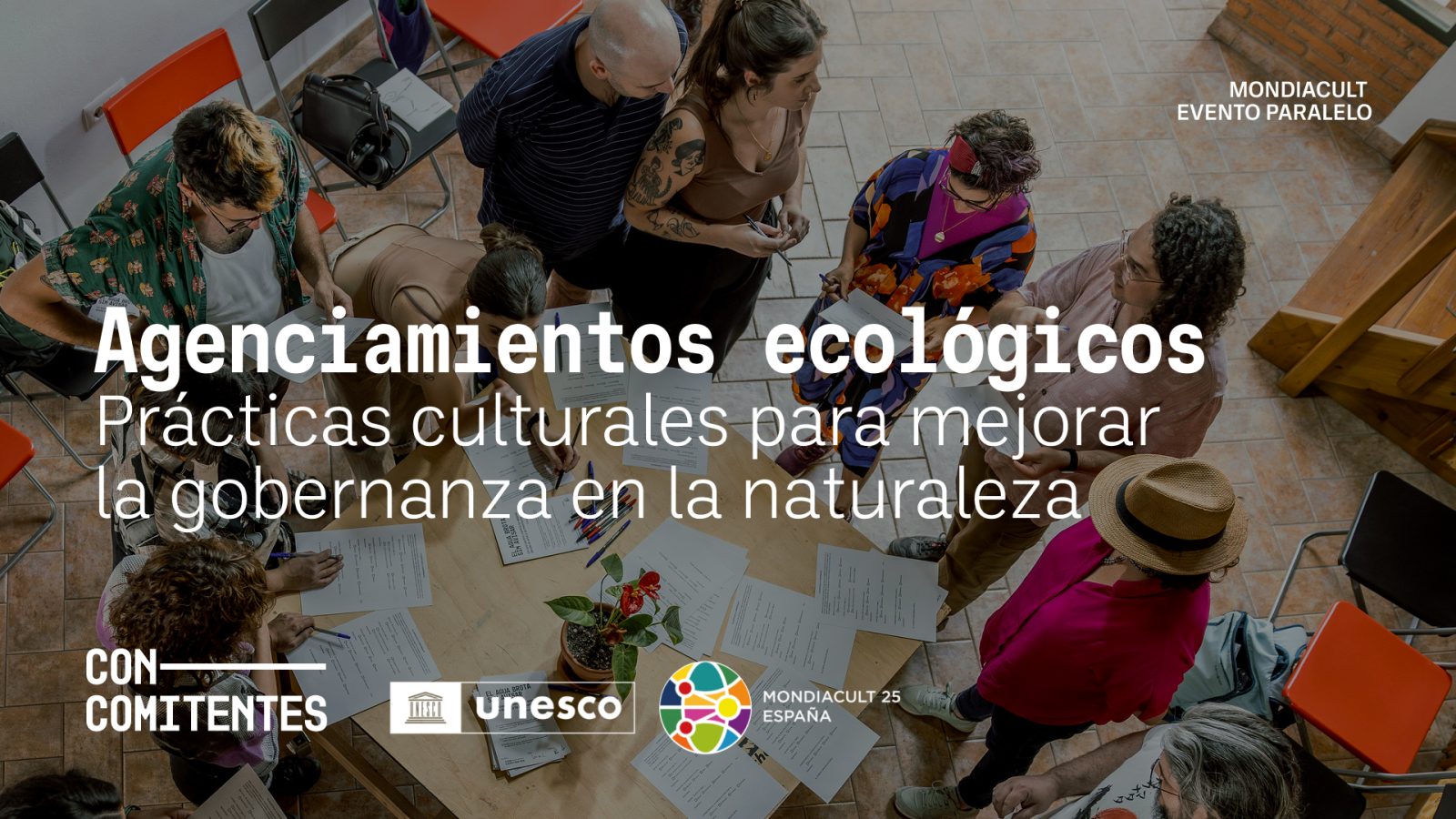
Concomitentes participates in MONDIACULT 2025 with a side event under the title Agenciamientos Ecológicos: Cultural Practices for Improving Governance in Nature, focusing on the relationship between culture and climate action.
This online meeting explores how contemporary art and participation can reconnect communities, territories and futures in the face of ecological crisis. Through concrete experiences, we will showcase artistic and cultural initiatives as open spaces for collective decision-making, community resilience and ecological and social repair.
How can communities self-organise to manage resources and address climate challenges? What tools does art provide for collective action and care? How can participatory arts practices re-imagine our relationship with nature and each other to build alternative futures?
Fran Quiroga (Director of Concomitentes) will speak with Graham Bell Tornado (artist and activist), Antje Schiffers (artist and co-founder of Myvillages) and Jose Iglesias García-Arenal (artist and mediator-curator) on tools, practices and key questions to foster new alliances between art, community and environmental transformation.
Graham Bell Tornado is a transgender artist, PhD in artistic production and research (Extraordinary Thesis Award 2020, UPV, Valencia). Her work explores the connections between gender and ecology from a gendered perspective. queer, as shown in the book Ecogender X (2019). Its practice is based on the performance and expanded theatre and includes video, music and graphic art. Since 2009 he has been organising exhibitions, workshops and conferences with La Erreria (House of Bent), an art collective and space. queer. Recent projects include Trans territory (2022), based on ephemeral interventions that reclaim the presence of a trans body in the rural world.
Antje Schiffers is a visual artist and her practice is embedded in different contexts, be it geographical (as a botanical illustrator in Mexico or as an itinerant painter in Russia and Central Asia) or occupational (as a corporate artist for the tyre industry or offering barter transactions to farmers). She co-founded the international artist collective Myvillages, based in Rotterdam. Since 2003, Myvillages has pioneered a new, artist-driven way of producing contemporary art with rural communities around the world, challenging entrenched images and cultural hierarchies between the rural and the urban in bottom-up cooperative projects.
Jose Iglesias García-Arenal works through curatorial artistic practice from Los Santos de Maimona (Badajoz) on long-term projects on the politics of memory and the naturalisation of extractive processes and heteropatriarchal violence that shape the territory we inhabit. He is a mediator for Non plus ultra in Concomitentes. Through writing, interventions in public space or audiovisual pieces, almost always in collaboration with other artists and different agents, he has worked on the colonial figure of the “desert”, the effects of the digital transition in the urban outskirts, the neoliberal privatisation of memory or the generation of sacrifice zones. Since 2019, she has directed the curatorial platform MAL, from where she develops research and creation programmes such as “Pantalla trémula” or “Salir del ritmo” through residencies, workshops, exhibitions and mediation processes.
Fran Quiroga is a transdisciplinary researcher and Coordinator of Concomitentes. He has directed experimental research such as ‘Montenoso’, ‘Fiestas Raras’ or ‘Ruraldecolonizado’ in art centres such as Matadero Madrid, CGAC or MUSAC. He is also coordinator of the project ‘Art Living Lab for Sustainability’ funded by the European Commission. He has co-edited, among others, ‘Mutaciones en el espacio público’ or ‘La fiesta, lo raro y el espacio público’, both published by Bartlebooth.
The session Ecological Agency: Cultural Practices for Improving Governance in Nature The event provided an exchange of knowledge in which participants shared artistic practices that connect creative experimentation with ecological and social transformation. It also functioned as a platform for dialogue that highlighted translocal cultural networks centred on rural, queer and decolonial perspectives. The meeting insisted on further strengthening alliances between artistic, scientific and activist communities; promoting public policies that recognise the role of culture in ecological governance; and disseminating participatory methodologies for cultural action and ecological co-design.