


Session 3: Conversation: Conversation: ‘Communities and Redistribution’.’
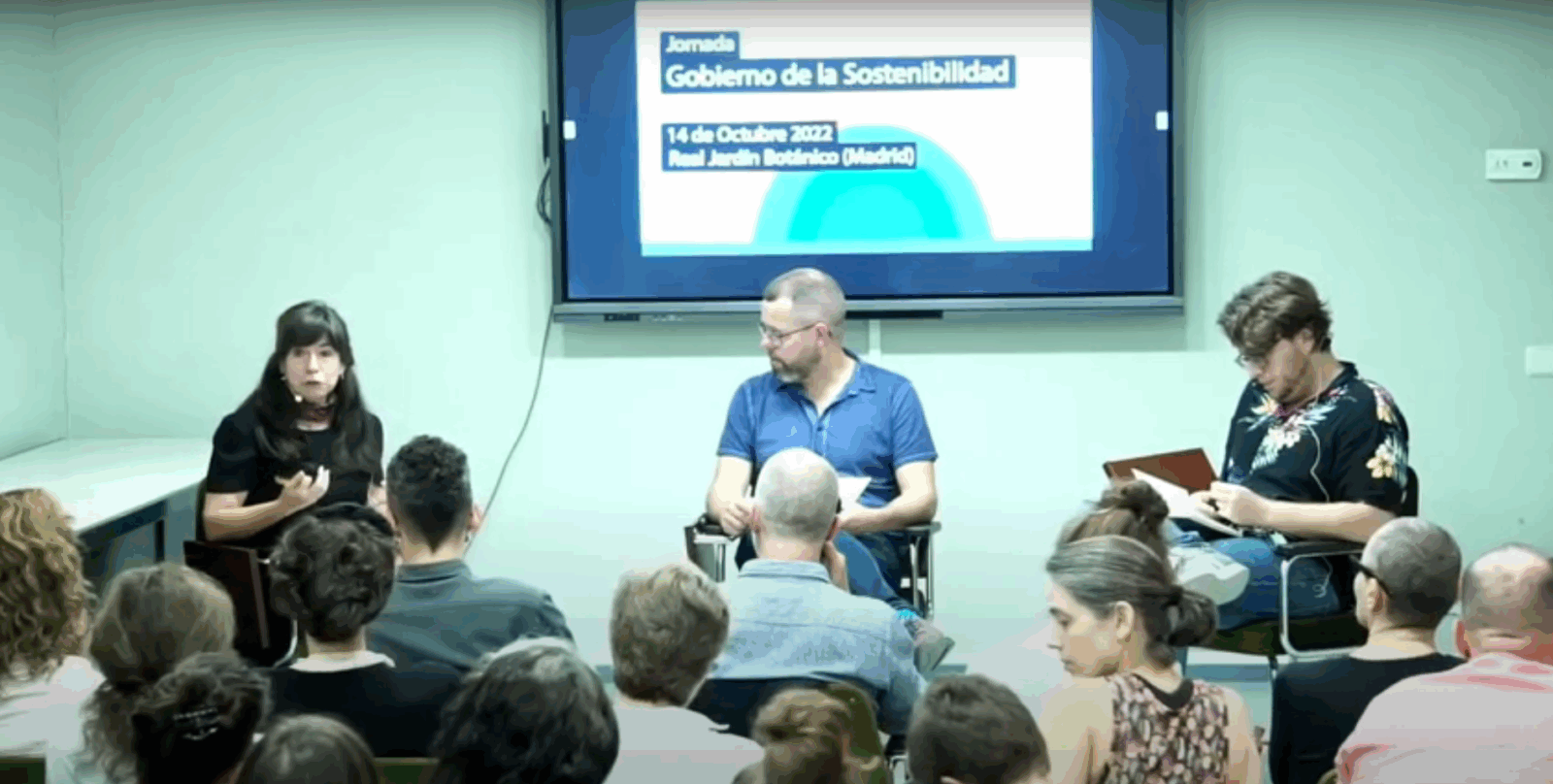
The session was moderated by Fran Quiroga, with the participation of Yayo Herrero and Emilio Santiago Muiño.
Concomitentes organised the Sustainability Governance Conference on 14 October at the Royal Botanical Garden, an open space from which to reflect on the way in which decisions are made and rights and duties are generated when it comes to addressing the future of our planet. A day co-organised with the UNESCO Chair of Environmental Education and Sustainable Development of the UNED, and in collaboration with our founding patron, the Daniel and Nina Carasso Foundation.
The last of the three sessions, ‘Communities and redistribution’, was moderated by the coordinator of Concomitentes, Fran Quiroga, with the participation of Yayo Herrero and Emilio Santiago Muiño. In his presentation and introduction, Fran Quiroga pointed out: “We must think about desire not from the individual but from the collective, political point of view, a capacity that art gives us to explore it (...) From our work we must rethink our idea of modernity, the epic and the artistic practices to which we are accustomed and rethink the use of public space”.”.
“We have created a culture that responds to a sacrificial logic, where the value resides in the monetary, everything deserves to be sacrificed if the counterpart is that the economy grows. Creating a myth of growth, (...) where the only possibility of sustaining dignified lives lies in the economy being able to grow”, explained Yayo at the beginning of his speech. “There is a divorce between what we consider human life and nature, resulting in brutal violence and absolute inequality. A culture built on the basic ideas of domination and violence, where some lives are worth more than others”.”, he added.
For his part, Emilio Santiago made a vindication of the different types of community, “if we understand community as the relationship of the interdependent, the state is also community, (...) on the scale of modern mass society”. He also explained: “The issue of justice has to be at the heart of any ecological debate, (...) we must guarantee the right to protection from the impacts of climate change. and, at the same time, look at the efforts to be made in proportion to the privileges built up.
Here here you have access to the video of the full session.