


Session 2: Conversation: ‘The Capacity to Produce Governance’.’
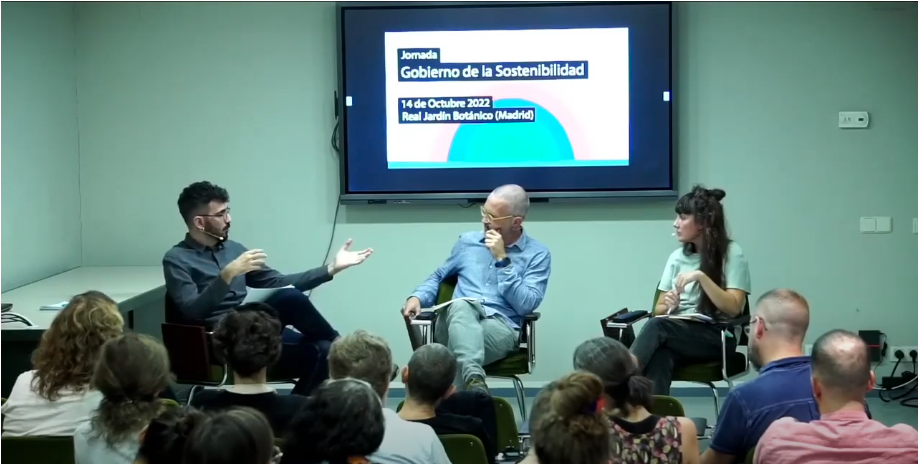
The second session was moderated by Sören Meschede, with the participation of Susana Cámara and Christian Alonso.
Concomitentes organised the Sustainability Governance Conference on 14 October at the Royal Botanical Garden, an open space from which to reflect on the way in which decisions are made and rights and duties are generated when it comes to addressing the future of our planet. A day co-organised with the UNESCO Chair of Environmental Education and Sustainable Development of the UNED, and in collaboration with our founding patron, the Daniel and Nina Carasso Foundation.
The second of the three sessions was a conversation: ‘The capacity to produce governance’ moderated by Sören Meschede, mediator of the concomitance Aguas Vivas, together with Susana Cámara Leret, artist and researcher, who analyses in her work the idea of territory and its transformation from the chains of contents that reveal her careful appreciation, and who is currently immersed in the project ‘Ecologies of hops’ in León, which works on agri-food culture; and Christian Alonso, Researcher, curator, teacher and director of the Centro de Arte La Panera in Lleida.
The exchange revolved around the capacity of art to create governance to generate processes of participation and co-creation. “We are interested in thinking that hops are much more than just beer and, from there, we want to approach the whole series of complex relationships that are part of the history and living spaces of the plant”.”, She added: “We are interested in working with the plant in a different way in order to relate the real with the symbolic and imaginary, opening up other kinds of possibilities».
For his part, Christian Alonso gave a presentation called ‘Healing with the bodies that inhabit the place: Multispecies Imaginaries and the Llobregat Delta’.’, This initiative, founded in 2016, is a transdisciplinary research laboratory for the generation of mediation projects and artistic experimentation: “We are committed to reconsidering urban life from a less anthropocentric and humanistic approach, based on inter-species egalitarianism”.”. He added: “We want to imagine materially interdependent and ethically responsible ways of life.
Two very different projects and experiences, but grounded in a situated context, within a common approach, the full content of which can be viewed here. here.