


Session 1: Conversation: ‘Nature as a queer entity’.’
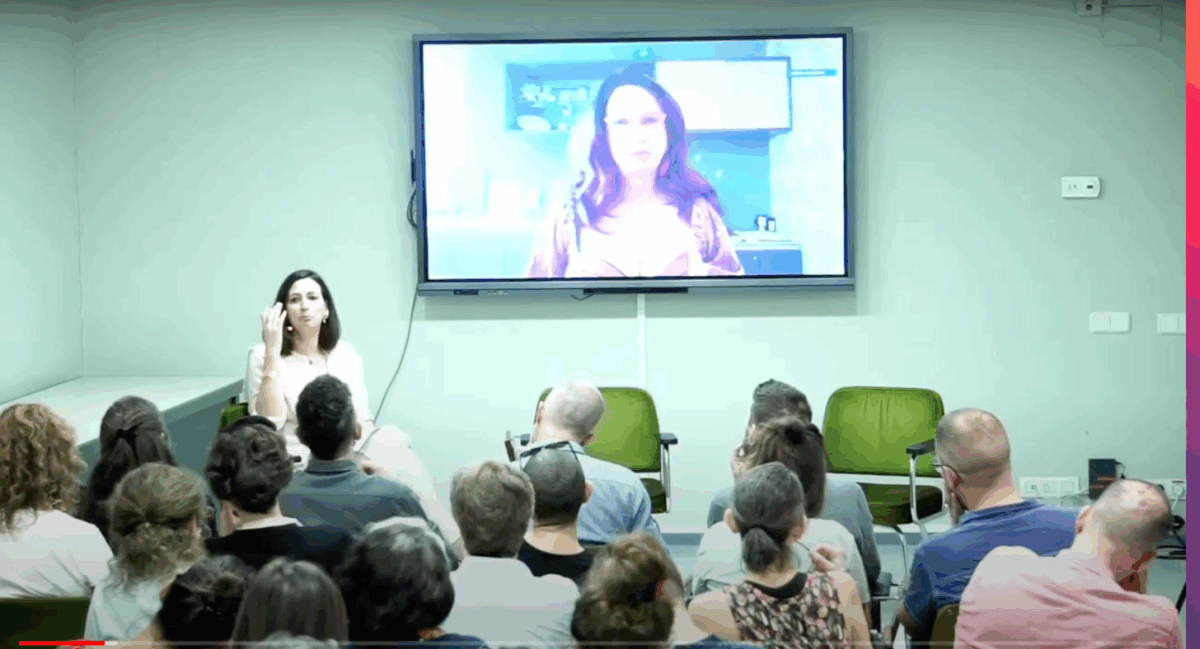
Full video of the conversation between Brigitte Baptiste and Isabelle Le Gallo, director of the Daniel and Nina Carasso Foundation in Spain.
On 14 October at the Royal Botanical Garden, Concomitentes organised the Government of Sustainability Conference, an open space from which we reflect on the way decisions are made, and rights and duties are generated in dealing with the future of our planet. A day co-organised with the UNESCO Chair in Environmental Education and Sustainable Development of the UNED, and in collaboration with our founding patron, the Daniel and Nina Carasso Foundation. The first of the three sessions was a conversation between the biologist and rector of the EAN University in Colombia Brigitte Baptiste and Isabelle Le Gallo, director of the Daniel and Nina Carasso Foundation in Spain., on ‘Nature as a Queer Entity’.
The conversation began with Isabelle, who provided the Foundation's strategic keys to its work in France and Spain over the last ten years: “We seek a systemic change in the set of laws, restrictions and state opportunities that can be found to transform the issues of sustainable food and citizen art, two areas in which there is a growing convergence”.”. In addition, the need for art connected to personal dynamics and processes was emphasised, in order to achieve a real impact and transformation in the social context in which they are located, being traversed by the causes of climate change and just transition.
For its part, Brigitte mentioned the loss of “human beings” ability to perceive diversity“, simplifying facts and reality in order to be able to ”operate more efficiently on it“, finding ourselves now in a moment of going back to ”making the scheme of relationships more complex, for which we need to change the tuning of our senses and our way of knowing in order to have the subtlety to understand how biology operates in the structuring of relationships between living beings".”. In this sense, the importance of “deep diversity, the small variation that occurs daily and is always present at the limits of perception, that is, the continuous modification of what we consider a pattern that emerges in order to ‘survive’, despite its intrinsic limits”, which causes us to lose the ability to perceive the subtle variations of everyday life that give rise to innovation, evolution and social change, came to the fore.
Queer economics is thus positioned as a proposal to look aside - with more attention - at ecological phenomena, the less perceptible signs in order to - from religion, science or mere curiosity or the accidental - remain attentive to reconnect sign and meaning, letting ourselves be carried away by that which “subtly seduces and invites us” to get to know the small signs that are continuously happening.
A temptation to associate biological behaviour with the values that move us as living beings, which we share with you in the full video of this first session (here).