

Quásares Meeting: a space to reflect on culture and health where the process of concomitance was told.
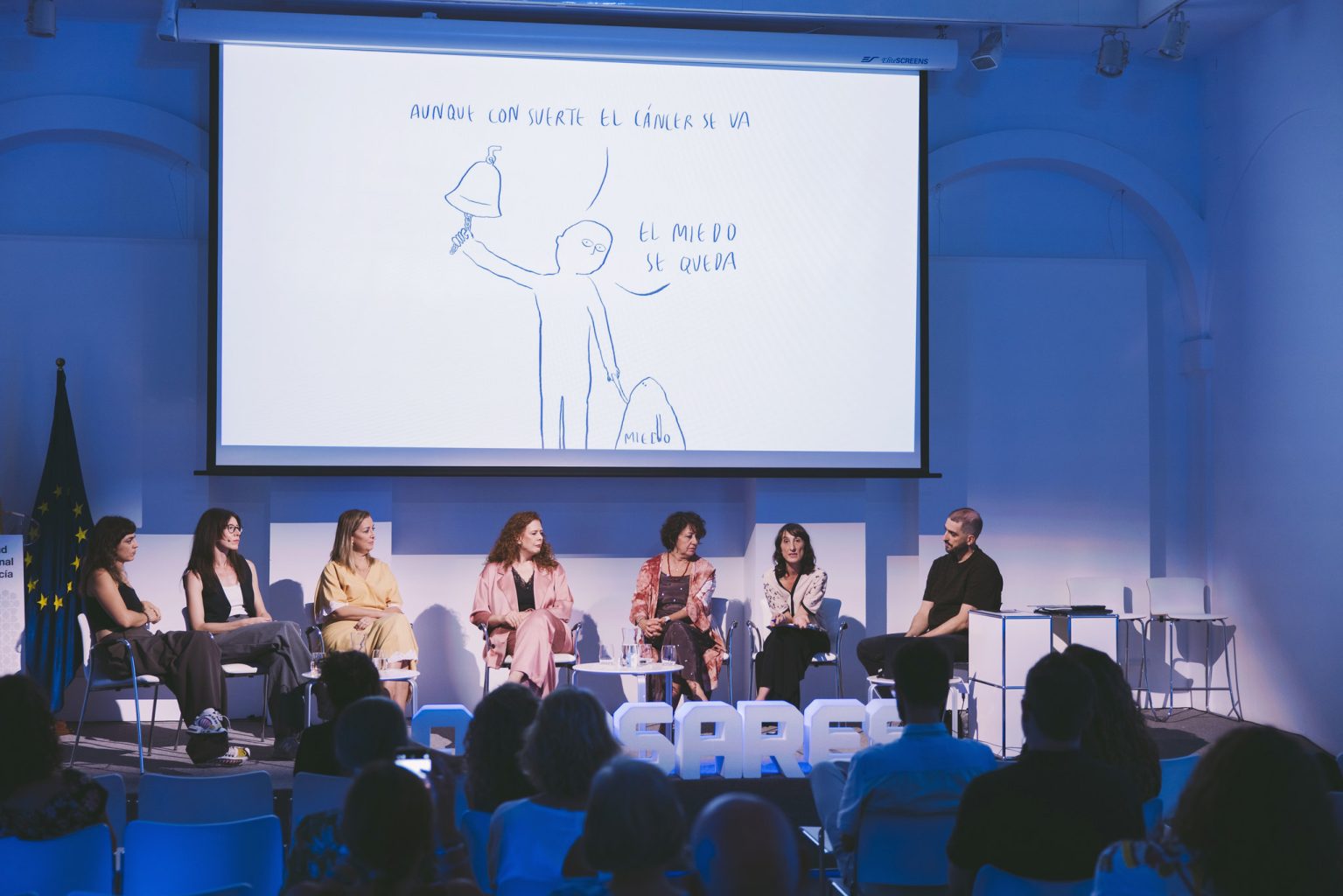 Photo by Óscar Romero
This is how the Quasars meeting went
In September 2025, the concomitant Quasars opened a space for conversation between those who care for, create and think about health from different places, but with a shared intuition: that art and culture can be forms of care. For three days, health professionals, cultural mediators, artists, patients and researchers met at the headquarters of the International University of Andalusia in Seville to explore what happens when these worlds meet.
From this emerged a web of experiences, debates and affections that gave shape to an expanding field: the interface between culture and health, where artistic practices are understood not as ornamentation or complementary therapy, but as tools of understanding, relationship and transformation.
On the project website (encuentro.quasares.es) the complete reports will be published. The one you are about to read is the one that corresponds specifically to the presentation of the Quásares project itself at the meeting. It is written by the project's rapporteur, cultural researcher Rubén Díaz.
Quasars, art and cancer
Conversation between Marta García Miranda (Cultural journalist specialised in performing arts and literature), Felipe G. Gil (member of ZEMOS98 and mediator of Quásares), Adela Angulo (Adela por dios; artist and illustrator, invited to the Quásares project), Andrea Morán (Sound artist, participant of the Quásares project), María del Pilar Muñoz (Oncology nurse and member of Quásares), Lucrecia Ramos (Oncology radiotherapy technician and member of Quásares) and Inmaculada Malasaña (Oncology patient and member of Quásares).
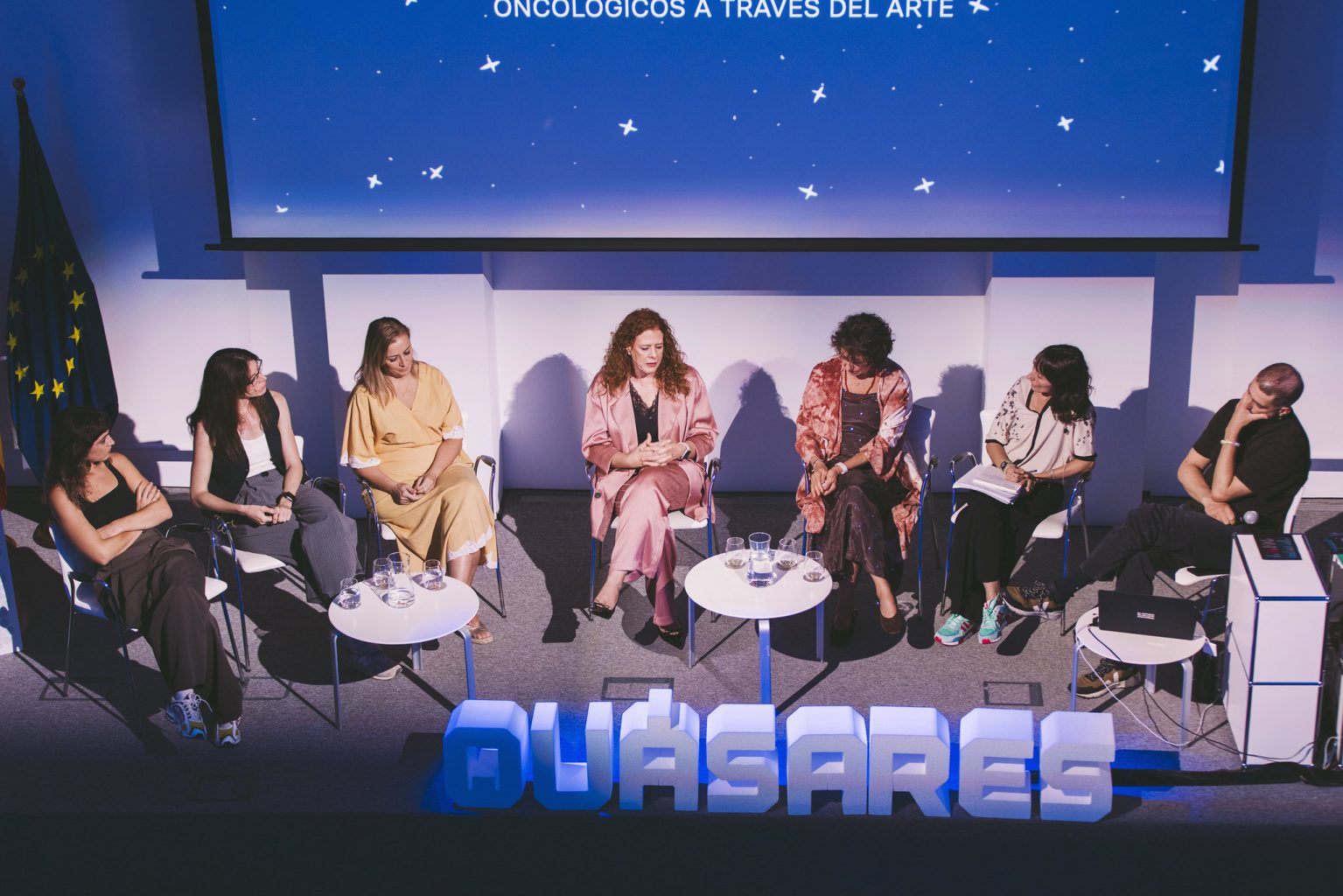
“Any rigorous process begins with research. What was the starting point of the process? Quasars?”, opened the journalist Marta García. And Felipe G. Gil, beyond referring to the background of the project, recalled his first visits as a cultural mediator to the oncology area of the Infanta Luisa Hospital in Seville: “I felt like an encyclopaedia salesman who nobody paid any attention to”.
If on the previous day the hospital had been evoked as a place of concern, rejection or fear, the image of a cultural mediator lost in its corridors evoked another kind of estrangement: that of the visitor who arrives at a place where he or she is not familiar with the hospital. non-place, in the sense of the French anthropologist Marc Augé. A functional and technified space where people circulate, wait, are registered, classified and treated. A scenario where life seems suspended. What I was looking for Quasars was precisely to open a crack in this linearity, a crack through which the story, the listening, the artistic gesture could slip in.
Without thinking too much about it, it was then that Lucrecia Ramos, a radiotherapy technician, showed Felipe the small cubicle where cancer patients hang letters written during treatment. Many of them repeat an expression of gratitude to the healthcare staff, especially the technicians and nurses who accompany them on “the patient's journey”: they are angels of light. “Although we give very little,” Lucrecia said, “these letters are especially useful to those who arrive later; in them they find comfort and companionship in the face of the fear and uncertainty that others have already felt. That corner of the hospital, apparently banal, thus became a counter-space: a place inhabited by affection, where clinical time was interrupted to give way to shared experience.
Among those letters, Felipe read one from 2015 that compared health professionals to quasars, celestial objects of enormous energy, “the most luminous in the universe”, capable of transforming everything around them. From that metaphor the project was born: an exploration of the emotional geography of cancer. Quasars who re-inhabit the non-place of the hospital and turn it into a territory of mediation and meaning: a human constellation where patients and professionals draw together a new cartography of care.
Marta García then intervened: “In mediation, it is easy to fall into the role of saviour. What dynamics help to contradict this prejudice of the parachuting mediator? Felipe answered without grandiloquence: ”I am not sure that I am doing something useful, but I am convinced that we are rigorous in the process. Perhaps we are partners in a common service.
Following the philosophy and methodology of Concomitentes, Quasars is constructed as a process of shared creation between people from the health sector and the artistic world. More than producing works of art, The project aims to generate cultural devices born out of the real needs of the hospital community, which can then be opened up to society and provoke conversation beyond the hospital. At the heart of it all is the collaboration between patients, doctors, technicians, mediators and artists, who dialogue to give shape to experiences capable of translating what usually finds no language.
For example, the illustrator Adela Angulo (“.“Adela for God's sake”) is creating a series of illustrations that, with humour and tenderness, portray the everyday emotions of cancer patients, dismantling the clichés of the disease and proposing a more human and closer look, “de-dramatised”, according to the artist herself. At the same time, the sound documentary maker Andrea Moran works on a sound piece that constructs a kind of affective map of care: conversations, silences, breaths, minimal gestures that often say more than any diagnosis. Both proposals share a common purpose: to offer emotional support through art, to make visible the affections that accompany the experience of cancer and to remind us that, even in the most clinical environment, creation continues to be a form of care.
“From where do you do it?” the journalist asked. Angulo, who completed her studies in medicine with a specialisation in family medicine and who practised briefly before turning to art, acknowledged: “When I was a family doctor I had a sense of control, even if I was talking about sensitive subjects. As a doctor, it was vertical. Here the relationship is more horizontal: there is an atmosphere of real communication where we share fears and vulnerabilities”. She added: “It was nice, but no longer shielded; now you are part of the process, we create it together.
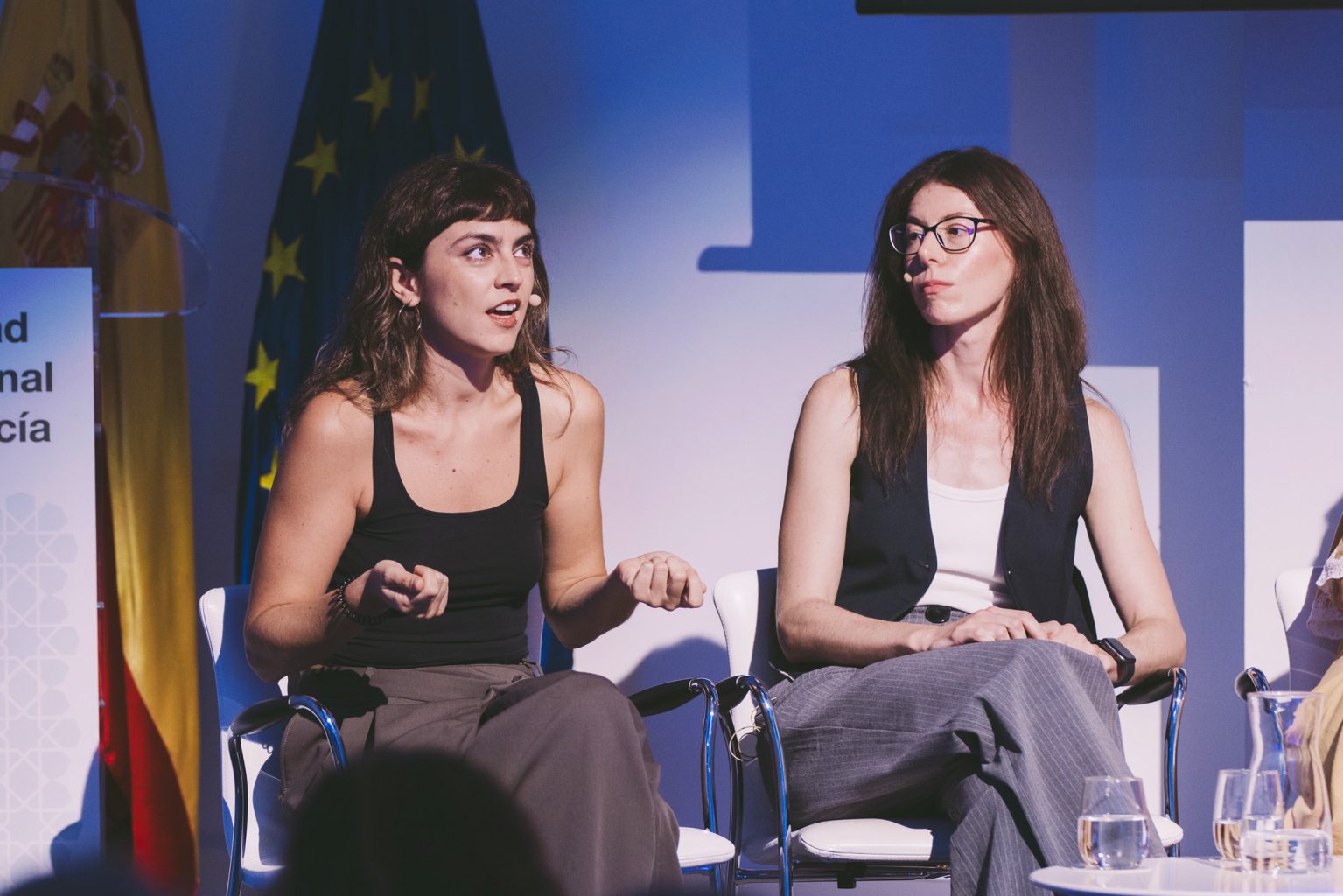
Andrea Morán agreed: she began the project cautiously, aware of the emotional weight of the material, but ended up changing her mentality. Felipe had reminded her that it wasn't about building archetypal characters or narrative twists, that she should forget about journalistic brands and also the media pressures she is used to as a sound documentary maker. Marta interjected: “And the red lines? Angulo immediately replied: ”I'm afraid of going too far. I want to say what needs to be said, but taking care how it is represented“. For his part, Morán explained: ”The red lines have been dissipating: if someone talks to you, they are giving you permission. It's not about making someone cry, it's about getting emotional with someone. There is an unspoken pact. But Angulo reflected: “I'm afraid of being invasive - how far can I ask? And she concluded: ”Sometimes things are not useful and that's OK. There are contradictions. Talking about cancer, not being a person with cancer... After the illness is also an immense space that needs to be talked about. Morán added: “Illness breaks linearity. It's a roller coaster. That's why we make short, fragmentary pieces that breathe”.
At that moment, a fragment of the audio interview with Inmaculada Malasaña, a cancer patient who participated in the project, was played. It was difficult to contain the emotion, not only because of what Inmaculada was saying - her story was hard, very emotional - but also because of the experience of listening to it all together, sharing her silence and fortitude, on stage, where she was accompanied by women such as María del Pilar Muñoz, an oncology nurse, one of the project participants. quasars. Inmaculada, as well as being a patient, had also volunteered at the unit after recovering from cancer, but had to stop because it affected her emotionally. “I know how a patient feels when they say ‘I'm cold’. I understand that. You can't take that cold away with a blanket”.
“In addition to treatment, we bring ears. It's not just about chemo. My unit is the most beautiful in oncology: it makes you think a lot, you take emotions home with you. I didn't know what I was going to contribute, but I knew that, as a nurse, I was the patient's spokesperson,” said Pilar. And Lucrecia Ramos added: “I have understood my work better through this project”.
Inmaculada was very generous in talking about the vulnerability of the oncology patient: “It's hard to recognise yourself as bald again. It was hard for me to look at myself. How can you want something with your partner? We feel strange, afraid. Living in fear is very difficult. We learn to keep quiet”. Lucrecia shared an important self-criticism: “For a long time, when a patient was worried about losing her hair, many of us said: ‘That's the least of it, woman, it will grow back’. It wasn't until a psychologist made us realise how inappropriate that comment could be that we understood its real weight”. Throughout the meeting, the relevance of gender has become evident. In fact, the voices of the project are mostly female. We see this also in the social perception of breast cancer, which is talked about as a matter of course, and the taboo of prostate cancer, even though it is statistically even more lethal. Perhaps because it attacks the man's virility. “It is the wives who usually speak for them,” confessed Pilar and Lucrecia. How can the gender issue not be taken into account in the health sector?
Women who care, women who are sick, women who accompany, women who speak out when the body is exhausted. Quasars shows that culture and health meet in that territory historically occupied by them: that of listening, empathy and mediation. But it also shows that care is not a private sphere, but a cultural and political practice. After all, in health and in illness, the personal is political.
Photographs by Óscar Romero.