


"Libraries are a place to experiment with the use of knowledge".
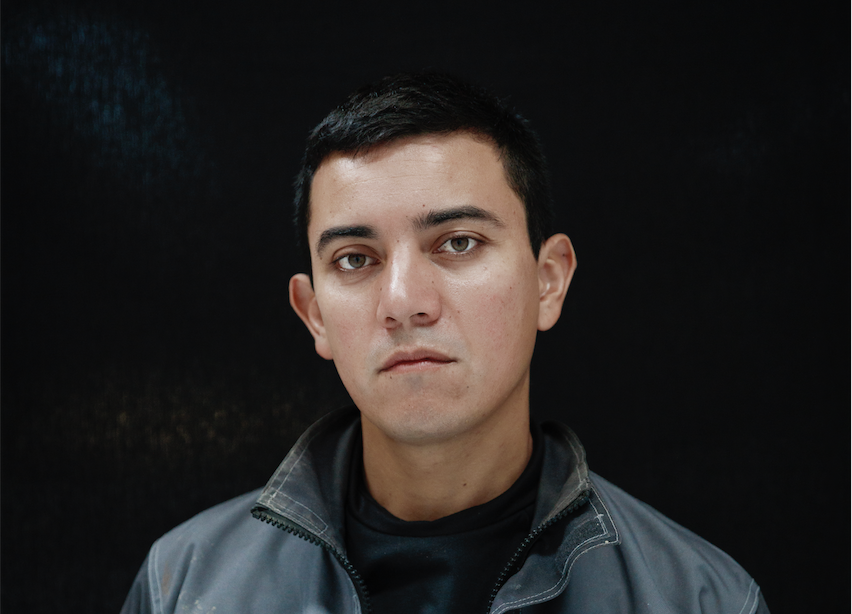
Interview with Iván Argote (Bogotá, 1983), artist of the concomitance of the Library of the Faculty of Fine Arts of the Complutense University of Madrid.
How to update the ways of doing things in a library, and how to tackle this transformation through an artistic proposal? The concomitance of the Library of the Faculty of Fine Arts of the Complutense University of Madrid explores the answer to these questions with the chosen artist, Iván Argote (Bogotá, 1983). In his first visit to the library at the end of March, the Paris-based artist connects with a line of previous works in public space that address the tensions and potencies of being together, such as the recent installations at France's Sorbonne and SciencesPo universities that he is currently working on.. The idea here is to continue experimenting with the forms of collectivity and encounter that libraries generate, in order to ultimately propose a work that celebrates new ways of being, studying and imagining together.
What is your relationship with libraries?
From Colombia, when I started university, I had a very special relationship with libraries, with a group of friends we invented strategies to navigate them in other ways. It was a place parallel to the university and my studies, where I experimented with my work. In fact, I made several installations, in complicity with the librarians with whom I established a friendly relationship. Libraries have been a place to isolate myself and collect my thoughts, but also to experiment with the use of knowledge and how to deal with so much information, generating strategies of play, a lot of play.
In the context of the Faculty of Fine Arts at the Complutense University of Madrid, what was your first impression?
It reminds me a bit of my university in Colombia, I like the university and library atmosphere a lot, with the books very visible and present, something that doesn't happen in many libraries. Also, the use of the faculties can be felt, the daily use of things, of the tables, the lockers, the doors... a different context to that of an exhibition, where, at least it seems, there is no use or no wear and tear.
«There should be more projects like this, in dialogue with a particular context. But it's very good to work independently, that's also necessary, not all art should be contextual».»
Today you are involved in two projects in these same environments, at SciencesPo and at the Sorbonne in Paris.
They are two important public commissions. The one at the Sorbonne is at the new faculty, Sorbonne Nouvelle, for a new architecture project, which we have been working on for about three years. I participated in it and worked with the students who sent us thousands of phrases that they found interesting from their culture, their language, their references, and with that I constructed and edited some texts that are going to be distributed all over the place. The SciencesPo project is also for a new faculty, similar and more recent than that of the Sorbonne, with the students of this university we did a workshop to confront a more sentimental writing with a more political writing.
So, yes, I am interested in making a commission that has contact with the people who are going to inhabit the place, more than me. In this case, in a faculty that is already in use, it is learning to collaborate with an administration that already exists, with spaces that already have their own uses and an independent life, beyond what any architect can imagine. It is nice to come to observe, to try to impregnate oneself and to generate other protocols of collaboration.
Concomitentes proposes the creation of art in response to a citizen's desire. How does this desire inspire, limit or determine you?
The fact that we are starting this collaboration has to do with the way I have worked before, a way in which I like to be very permeable to the context, I find it very difficult to come and implant something in a place where I am a stranger. There is a kind of pleasure in getting to know from the language, from words to corners or uses, to build a complicity with the people, with the place. Therefore, the challenge and the complexity is to be able to generate something that goes in that direction.
How would you say art should speak to and connect with citizens?
It is also good to be able to isolate oneself or to generate more abstract discourses. But I do believe that at the moment we need interaction, closeness, contact.
«It's still too early to tell, but there are several things that I find interesting. One is the architectural form, as there are some spaces that I find interesting that are in disuse or that have other uses».»
Is there a common thread that connects all your work?
In my work there are several questions that are important, that have to do with the relationship we have with history, with the past, with heritage; but there is a question that runs through all these questions about how, through the way we relate to the other, we can question or criticise our relationship with history, with power or with the economy. There has always been a concern to generate actions with others in the street, in transport, in places, in museums, outside or in a park, but I also like to make structures or sculptures that are usable, that you can sit on or that are mobile, to interact with others through play.
Do you know which line to explore for Concomitentes' work?
The relationship with the vegetal and obviously the relationship with the library and how it can do something more tentacular, not only within this faculty and this perimeter of a hundred metres, but perhaps go beyond, in another way that is not necessarily physical. For now they are notions, there is no idea or direct illumination, it is a process that comes with observation, with experience, with a little more work.
How was your first encounter with the commissioners and the commission?
Coming here today and discovering the faculty, the library, is quite sweet. It's like meeting a person, an entity. There's a catalogue in which I left a little dedication for the library that said «nice to meet you, I'm sure we'll get to know each other better». So far it has been a very pleasant experience, there is a lot of information that I have to process. I think it can be something that is born from here and that, like books, it can go anywhere, like the labyrinth that it is, and that it can go anywhere.