


"The important thing is the meeting place that this library makes possible".
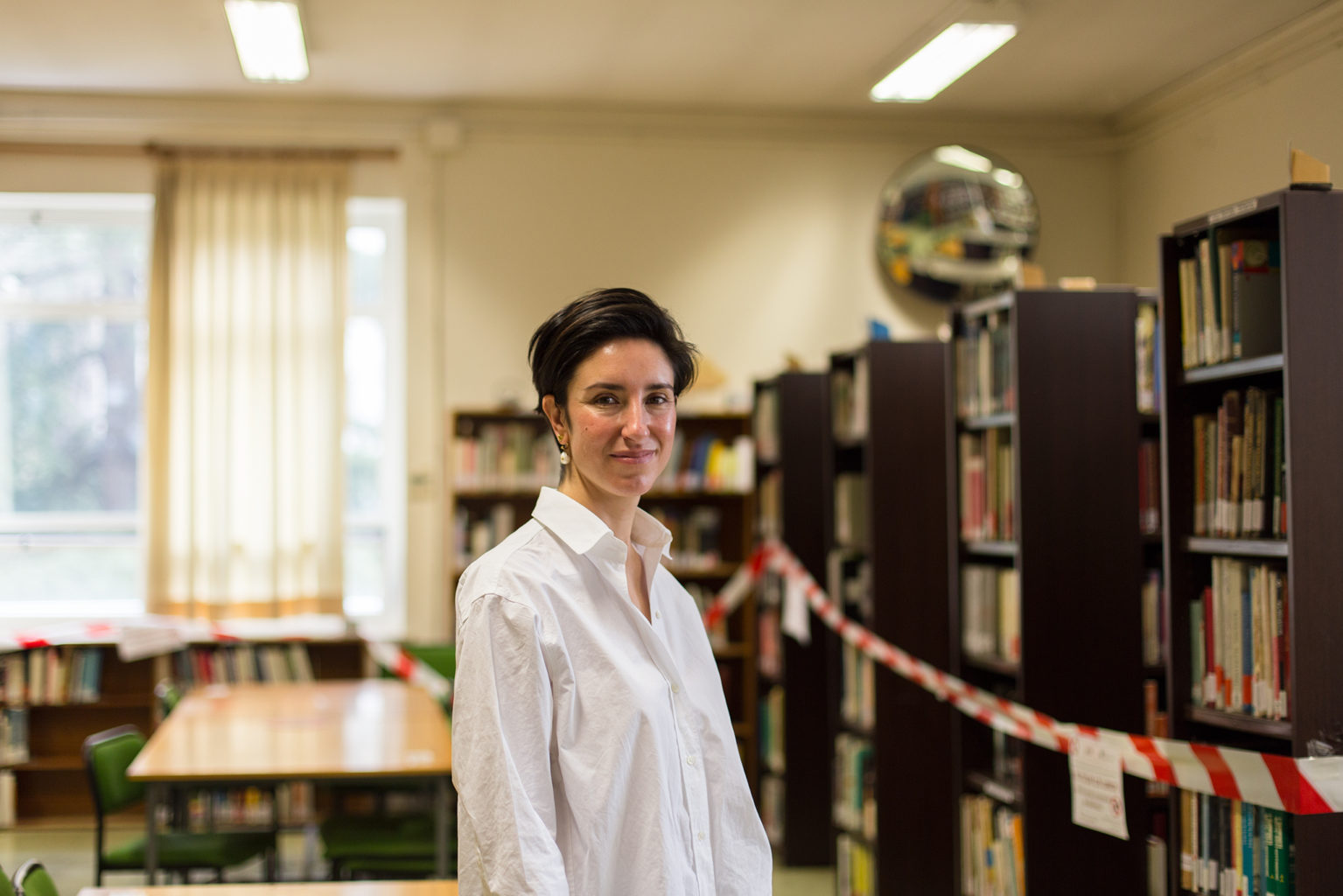
Julia Morandeira, mediator of the Fine Arts Faculty Library project, tells us about her experience in this project.
The mediator's work is the backbone of, runs through and determines the entire Concomitentes project. As Francois Hers' protocol literally explains “The mediator organises the cooperation. He or she provides the necessary knowledge in the choice of medium and artist, as well as the skills to ensure the production of the work, taking into account both the requirements of the commission and those of the creation”.”. Julia Morandeira Arrizabalaga is the mediator of the project of the Library of the Faculty of Fine Arts, our concomitance in Madrid, and in this interview she tells us about the experience and process of carrying out this work.
How do you become a Concomitentes mediator?
The concomitance of the Library of the Faculty of Fine Arts began before Concomitentes, when Javier Pérez-Iglesias, the director of the library, learned that the project was beginning to be articulated in the Spanish context, specifically in Madrid. There he approached with the will, with the initiative, of wanting to propose the library as a place to formulate a commission.
With what initial objective do you start working?
His first intention was to work on the organisation of the library, he felt that, despite all the gestures activated, with a whole series of programmes, activities and actions that are seeking to open up the library to other ways of doing things, there was still a problem within the structure of the library itself. A spatial structure of how the spaces are organised, how the bodies that use those spaces are organised, and also the contents themselves, the classification of books, documents and materials. The feeling was that the library was not responding to certain uses, to ways of doing and being in that space that were current, or even that there could be future ways of doing and being in the library.
What mediation methodologies are active in this initial phase?
We activated mediation strategies centred on a recognition of the physical space and also of all the processes, experiences, people who inhabit and make this space with their actions. One of the first things we started to do was to talk to all the people involved in this recognition, setting up a form of active listening to all these processes, all these people and experiences that shape and build the library. On the other hand, we also did a reconnaissance of the space in which we tried to work from a somatic perception, from the body, from the choreographic. How are the bodies that move in this library, what gestures do they reproduce and make, what gestures are codified in this cultural space, what collective but also individual choreographies are drawn in this space and, finally, we worked on the capacity for speculative imagination. If we are thinking about how the doings of the present can have repercussions on the way we make a library in the future, what kind of library we want these later generations to inherit.
What inspires you to activate this process?
These are methodologies that come from the feminism of the 1970s, which have been developed in the heat of opening up other forms of political imagination so that we do not remain blocked and stagnant in a present that is often seen as having no alternative. This allows us to think in a situated way about what we are doing now and to make us responsible and co-responsible for the consequences in the future.
What do you activate after this initial phase?
After this first phase, we realised that the library is a collective organism, porous and very open, very large. The group we were working with, Javier Pérez-Iglesias and Amelia Valverde, and close collaborators such as teachers, students or workers who also live in the library, realised that this idea of the library was much broader and that we needed to generate a mediation device that would allow us to collectivise the formulation of the commission. That's when we worked on the construction of Ranganathan, a study and work group focused on how we can think collectively about the library, taking as a starting point the library of the Faculty of Fine Arts, but radiating to other libraries, to other ways of making the library, using and being in this space. In short, we began to generate a whole, much richer device that also made it more complex to think together about what the library is today, what we want it to be and what it can be.
Where does the name of the group come from?
We take the figure of Ranganathan as a name, but also as a force of inspiration for the project. Ranganathan was an Indian librarian who, at the beginning and during the second half of the 20th century, developed a great work within the field of librarianship, in fact his five laws are still the ones that articulate and order a great part of the libraries at an international level. We wanted to make a gesture of recognition of non-Western legacies in the world of the library, which, let us not forget, is linked to the idea of the archive, which has a profoundly colonial origin. We also took Ranganathan's five laws of librarianship and adapted them to our project as a kind of guide that would also bring order to different horizons, both of action and of thought.
What next steps are activated after this stage of inspiration and encounter?
Another extremely important element for mediation was working with Sagrado Nova, a facilitator and designer of services with whom we worked on different strategies and spaces for co-creation. That is to say, if we understand the library as a place where there are different points of contact with users and as these uses are what make up that library as a place of services, how can we think, through these services, also about how to reformulate the library? Sagrado's work was crucial in this process, to facilitate the debates, the conversations, the questions, above all to lead or design different workshops that made it possible to reach a series of conclusions that have allowed us to understand the commission in a completely different way from how we started.
What are the conclusions of this mediation process?
The main conclusion we draw from all this rich, dense and rich process of mediation has been that the first intention that focused on intervening in the structure and spatial order and contents of the library was a very limiting and limiting position. It led us to want to correct the library, to want to repair it, to want to change it from a physical and material point of view. What we realised is that, in spite of the structural limitations of the library, what is important is what the library does, a sort of compendium of activities and knowledge. The meeting place that this library makes possible, with ideas, with books, encounters, with oneself, encounters with different reading processes. Encounters with ways of understanding the library, the collection, the collection, knowledge, knowledge, experience... But, above all, in the discussions that open up here. This encounter, with this potentiality, which is not subscribed or restricted exclusively to the physical space of the library or to the order of the library itself, but what we really want to do with this project is to underline the power of this library.
How would you define that power?
It is a power that can also be activated or updated in this space of the faculty or in other libraries, we understand that the learning that we have produced through this experience, come to underline this capacity for encounter and this specificity of ways of doing things in this library, but that they come to be a celebration and an activation of these encounters in a space beyond this library itself.
How to translate these conclusions into a commission?
The assignment is formulated as follows: How can we generate an intervention, how can we imagine an artistic intervention, that gives an account of this capacity for encounter, of this singular librarian doing that occurs in this library, but that also emerges in other libraries and even in other spaces that we do not name as a library, but that, in some way, breathe and activate these ways of doing, allow these encounters, and that these potencies of knowledge and experiences occur. Therefore, now, the commission operates on a level fuller of possibility, the way in which we have articulated the commission is a place in which to imagine interventions that transmit, that communicate and that celebrate and activate this idea of the library and this way of making a library.
How, as a result of this mediation and commission, do you choose the figure of the artist?
Bearing in mind how the commission was articulated, I thought about how, through the language of sculpture, we could give an account of or activate a library, not only as a physical space, but also as a way of doing things. Here I am thinking of Iván Argote, Iván, an artist of Colombian origin based in Paris, whose sculptural work reveals a lot about ways of doing, in which he tries to summon a collectivity. Iván's work is closely related to his sculptural practice and in the language he develops there is a central concern that palpitates and tensions the way in which his projects are then formalised, which has to do with how we live together, how we can live together in another way, how these ways of being together are, with their tensions, conflicts, consensuses and tenderness with violence.
A very complete artist with many facets...
Another fundamental aspect of Iván Argote's work is his relationship with language. For some time now, much of his work has been incorporating forms of writing, language in the city, in bodies, in public spaces. A language that draws heavily from the poetic, from a language that is not transparent, juridical, but whose interpretation and reading summons up many images, forms of interpretation that are not unique but multiple. On the other hand, not only this poetic capacity, but also this inventive capacity, this capacity to invent new words to fill them with new meanings.
Of all these ideas as to why Iván Argote responds and is so well suited to this assignment, which one would you highlight?
Iván Argote is ideally suited to work in the context of this commission because of the formal sensitivity he has for generating spatial interventions around the collective, around the communal, and relating this to an expressive capacity for language.
How have the commissioners reacted to the artist's selection?
The reaction of the clients to the choice of Ivan was exceptional from the very first moment. It is true that Iván is a person who has an exceptional human quality and capacity for listening and generosity towards people and the contexts in which they live. Iván has also worked a lot in collective processes, his work draws on experiences that reflect these processes and he has also been linked to other forms of education with children, with adolescents, that imprint ways of relating to contexts such as, for example, that of a concomitance, in which citizens commission a work of art.
What has it been like to deal a little more politically with the university environment, which is also part of your work as a mediator?
One of the particularities of the Concomitentes project is that it encompasses different temporalities and different processes of work, conversation and mediation, which also have to be carried out simultaneously. Therefore, the negotiations with the different authorities that govern the spaces we are now investigating, in order to be able to intervene or imagine the installation of Iván's work there, have also been parallel to the mediation process. We are now thinking that the intervention, as a way of celebrating the library, can in fact emerge and be in any other context, other than exclusively that of its origin. We are opening up, in a way that is always respectful and listening, to what are the needs, the requirements, the obligations of each space in this whole process of conversation.