

We are determined to tell you that this is extraordinary.
Ana Moure Rosende Ana Escariz Pérez
Comeza o processo de traballo de Os contos do leite, unha retaguardia cultural que defende a Ulloa como un territorio vivo e cheo
Dear readers,
We are inaugurating our virtual blog by sharing the learning and details of Os contos do leite. In this space you will find, on the one hand, keys and methodologies of the mediation process and, on the other hand, knowledge cultivated by the participants. Thus, we want this testimony to fulfil a double mission: to tell the story of the development of this comitancia and to give tools to future mediators who want to put participatory artistic processes into practice.
On 15 October we began the dairy journey that will take us through different fields, artistic practices and scales linked in some way to milk, up to the moment when the selected artist begins the process of producing the work of art.
A few days before our first meeting we sent a guide to the group of clients where we explained that during the time we will work together, we will work with different elements related to milk (soil - water - cows - yeasts - digests -) using two types of meetings:
storytelling sessions, which consist of meetings where we tell stories and exchange opinions about a specific element related to milk. The aim of these sessions is to share information and opinions in order to gradually generate a common framework.
the "do viva voce" sessions, which consist of carrying out actions related to the element related to the milk we are dealing with. The aim of these sessions is twofold: on the one hand, to try out strategies and ways of doing that arise from the artistic field to experiment with different formats and see which ones interest us most with a view to the final commission, and on the other hand, to generate media impact in the fight against Altri.
Thus, in the second week of October we held the first sessions, which were linked to the «earth» element.
TO DO IT LOUDLY. EARTH
To begin with, we thought it was important to tackle the land where Altri intends to set up.
For this first session we contacted Iván Orois, a graduate in biology and a great connoisseur of this territory, so that he could accompany us on our tour and help us to better understand the specificities of this soil that make Careón such a special place. At the beginning of the session, Orois himself tells us: «I am determined to tell you that this is extraordinary». The glow of the exceptional is installed among us from the beginning and accompanies us throughout the session.
We met in an area that the mediators called Careón with some doubts, because comparing land ownership plans, soil types and level maps, things did not coincide: there seemed to be two Careóns, Careón mountain and the Serra do Careón SAC.
This was the first thing we discussed with Iván. We then discovered that the people of the area only call the top of the Careón hill, while for the rest of the territory there is abundant microtoponymy. We thus discovered that the name «ZEC Serra do Careón» is in some way an invention, as is the term «os Ancares», as Iván told us, to which the inhabitants refer with specific names for each mountain.
Before leaving for our excursion we observed Landscape series #1, by Nguyen Trin Thi, a piece in which the Vietnamese filmmaker reflects on the idea of the landscape as a silent witness to history, based on a montage of slides in which people appear pointing to something we don't get to see. The landscape in which we see this video intrudes on it, incorporating its sounds into the images of Vietnam that we see on the screen.
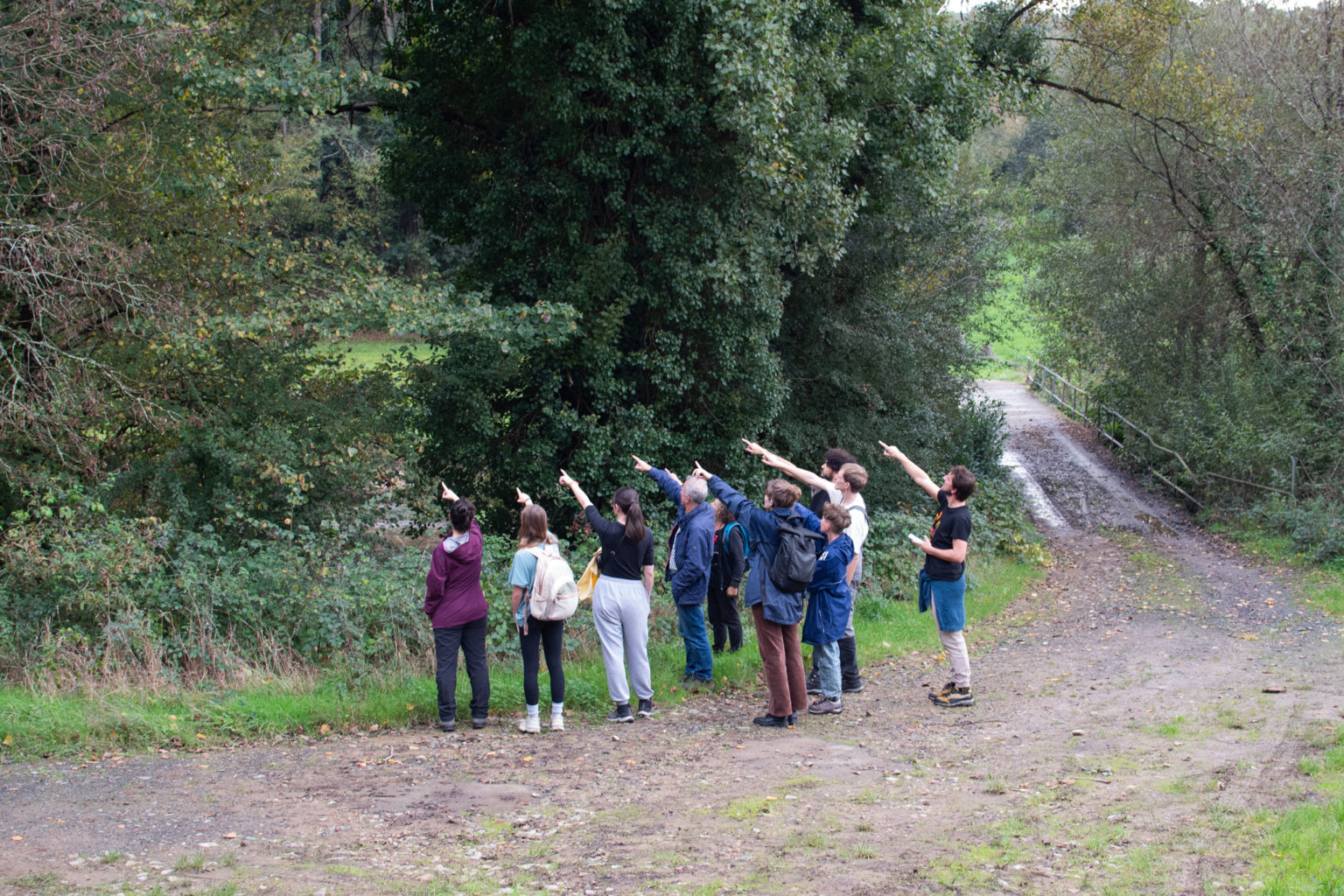
Borrowing some of the techniques we identified in this piece, we propose to do our walk in performative mode but turning Nguyen Trin Thi's piece on its head: if Landscape series #1 seems to be talking about a dramatic or catastrophic past, we invite the group to point out, as we walk and talk, elements of the landscape that we want to preserve and protect against threats such as Altri.
We point out and talk about the serpentine rocks with which the houses we see in the area have been built; about trees such as elms, which have been in the process of extinction since the 19th century because of a beetle; about how with climate change the notions of native and exotic species may become obsolete since, if we think in the long term, it might make more sense to plant cork oaks and strawberry trees in Galicia than ash or oak. We also hear the buzzing of velutinas flying under some apple trees and see an old bee hive in the same area. We talk, walk, point and take pictures. The camera clicks, clicks, clicks. And we remember the sound of the slides of Nguyen Trin Thi's piece: clack, clack, clack.
When we reached the highest part of the route we took, we saw plants such as the only green flowering heather in continental Europe (Erica scoparis), which some people use to make sun loungers and parasols in Camariñas, making use of the resource in a way that benefits the heather itself. Once again, the cooperation of humans with their environment. At last we see two of the media stars and endemics of the area, the plants Santolina melidensis y Sagina merinoi, which are a natural treasure of the Careón.
We also talk, on our walk, about the relationship between livestock and space: we talk about maize and how unsustainable its monoculture is, how in Galicia farmers have little territorial base and resort to this crop to meet market demands. Iván also tells us that many of the endemic plants that we see in this area “we don't bother them». These hardy plants are able to thrive in areas trampled by large mammals, a condition that eliminates other competing plants such as pines. This whole area was more like a savannah in the 1950s, when the grazing of cows and sheep in the area favoured the appearance of these plants and flowers, as these herbivores ate up the competition from the pines. The use of the land for livestock was a way of replacing the ecological services that used to be provided by wild herbivores such as deer. Now that these soils are no longer trodden and there are no longer animals grazing on them, the pine trees are growing and there are fewer and fewer plants left. Thus, Ivan insists on the nature conservation achieved through coexistence between humans and non-humans in the territory.
Iván tells us that his dream would be to buy the Quintas farm (which Altri wants to use to install macrocellulose) and put the cows out to pasture there. The whole group quickly starts talking about the possibility of buying the farm together, of crowdfunding to protect this territory. Even if Altri's proposal were declared strategic, they could expropriate the land, but expropriating 1000 owners would not be the same as expropriating 1! We spoke enthusiastically about the possibilities of approaching the fight against Altri from the perspective of land ownership.
The sun is starting to go down. We should turn back.
We reached the cars and shared one last reference: L'horta, neither forgotten nor lost, by Anaïs Florin. The commissioners connect a lot with this work, which they particularly appreciate for its public impact and archival work. We will talk later about how we can appropriate some of these techniques.
STORIES OUT LOUD. EARTH
For this session we meet at Eira da Xoana. Marcial, who manages it, joins the session.
We set the table and show the group the trousseau that we will be building little by little as the sessions progress. The first pieces we have were given to us by Luis: some cloths that he uses in Arqueixal to absorb the whey from the cheeses, some ribbons with which he wraps them while they are curing and an old birch wood cheese-making bowl. We talked a lot about the cheese-making profession and about some of the people who still make cheese in the area today.
They quickly think of all the other items that can be added, such as the gauze fabrics that Natalia uses to make vegetable milk. Today we drink Sen Máis milk. Marcial gives us a taste of honey and Vanesa brings us some homemade apple pie. We also explain that our idea is to try different milks in each session, to make it our inside joke: to bring a milk that is somehow related to the topic we are dealing with.
This time we continue talking about land, soils, pastures... We share some stories and references on this topic. We have brought some printed materials and others are based on conversation. We read an extract from I sing and the mountain dances, by Irene Solà, which leads us to talk about the mushrooms that abound in the area. We listen and talk about Embolism by soleá, by Paula Bruna and we return to talk about different actions that we could carry out. We discussed different artistic approaches, insisting on the need to speak from the positive at this moment of the struggle.
We told them that the reading of the Manifesto of the Ulloa Viva Platform reminded us of a text by Emilio Santiago Muiño entitled Luxurious poverty: retrospective of a cultural revolution. In it, Santiago Muiño writes a letter to Jorge Rietchmann from a future 2060 in which a cultural revolution has established an austere utopia in which things are not as terrible as they may seem to us in 2024. We propose that each one of them do the exercise of writing a sentence, and writing in the voice of some element on the ground, as Irene Solà does in her book, how she imagines life in 2060. Each Contos session will end with an exercise like this to gradually imagine a future 2060 in which Altri has not settled.
In this way, Os contos do leite begins its journey strengthening resistance, encouraging the struggle and celebrating our land.