

And yet there are love stories
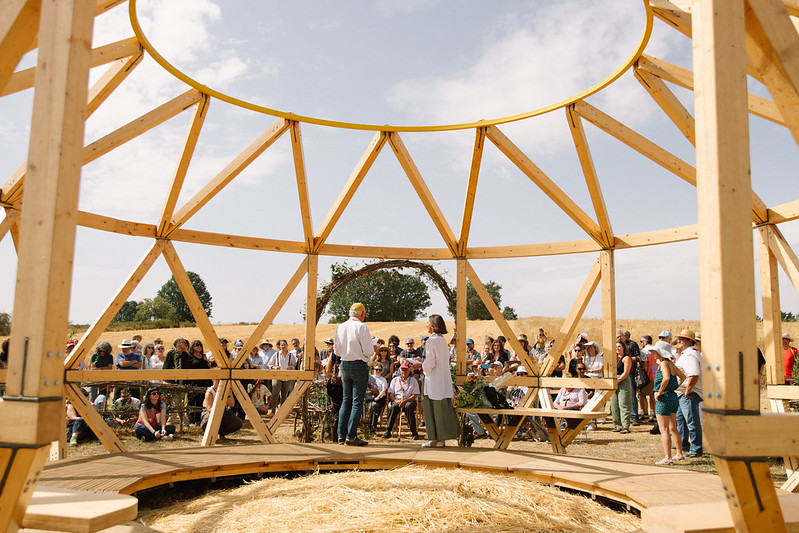 image by Raquel Santaolalla
Reflections after the inauguration of Solaridades
Living 14 years in a territory like La Sobarriba (those are the years I lived there), can give you the dimension of what its inhabitants are capable of doing. Of what they are capable of doing with their hands and their actions. Of the capacity they have to create possibilities for a better future in community. But I never cease to be surprised by the capacity of the women and men of this territory, and of many others throughout Spain, to continue constructing non-hegemonic narratives about what it means to inhabit the peripheries.
Says Byung-Chul Han in his book 2023 The crisis of narrativeNarrating requires attentive listening and concentrated attention. The narrative community is a community (...) that listens attentively«. And this is what some of the residents of La Sobarriba have been doing for the last three years. Re-listening to each other and rediscovering what it means to be rooted with others in order to weave a community that, beyond the eco-social struggle that originally brought them together, is rooted in care and affection. With what is human and with what is more than human.
On the opening day of Solarities Marina, one of the commissioners, said: “I am going to talk about what I feel and value about this land”. The commissioners of Solar Narratives have been demonstrating an immense love for the territory of Sobrarbe. But this is not a blind love, given without question. On the contrary, this love for the territory arises from certain questions about belonging and identity. What it means “to be from”, “to be born in”, “to live in” or “to belong to”.
The community to which these members belong can be summed up very well in two of the events that accompanied us on the opening day.
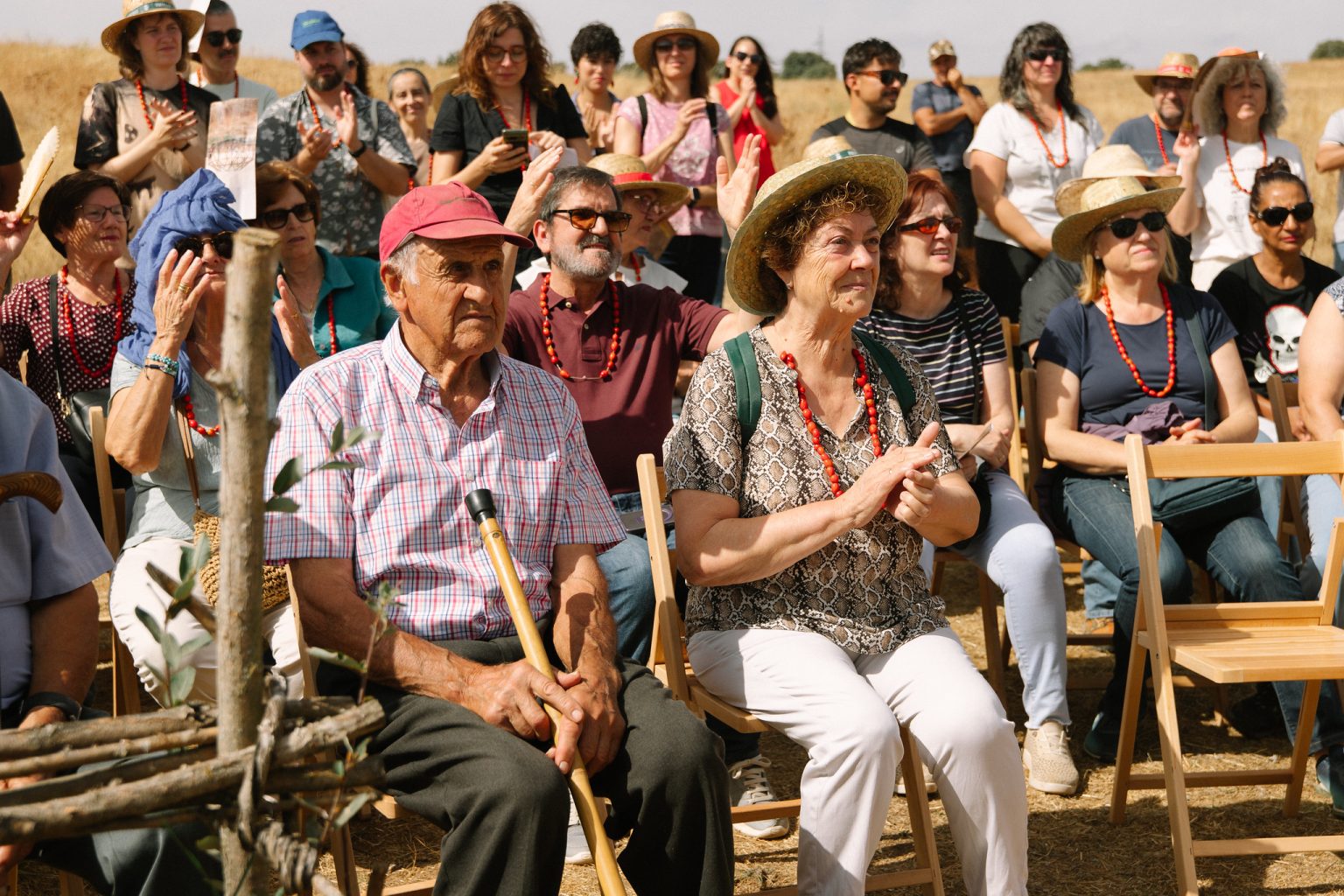
The first one has to do with a present that was given to some of the participants who had collaborated in some way in the construction process of the piece. This gift consisted of a necklace of agavanzas or rose hips (the fruit of the wild rose) that was created by neighbours of the region, sewing them in the afternoons of the incipient autumn. Choosing this fruit and offering it in this way speaks to us of a community of the small, far from the great centres of power, a community that looks with eyes full of love towards every human and more than human inhabitant, a community that, like the wild rose, grows in the territory despite the difficulties.

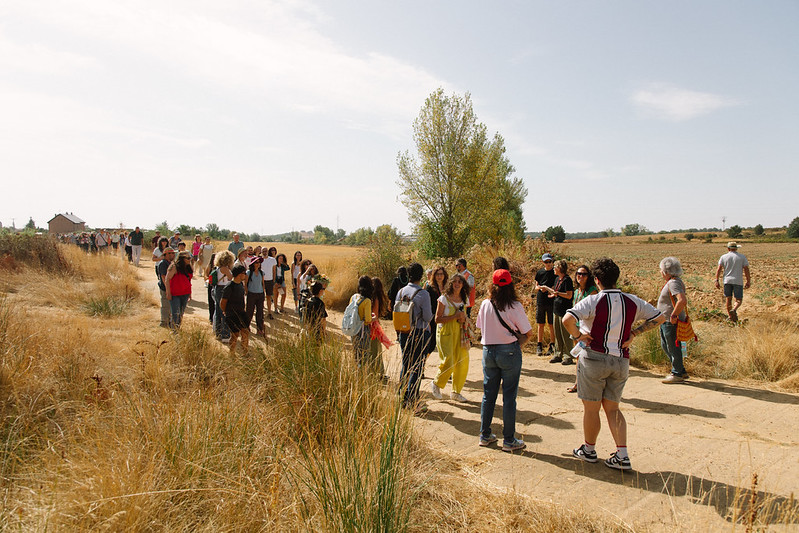
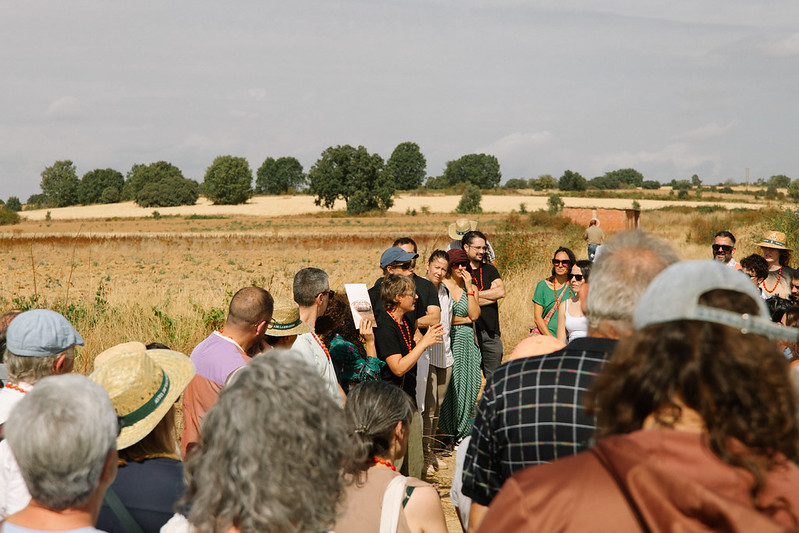
The second act refers to bodies. Putting bodies into acts of resistance as simple as walking along a path surrounded by mown fields, yellowed by the great drought that has ravaged Castilla y León this past summer, fleeing from the immediacy that progress demands of us in order to feel every little sound, smell or shiver of emotion. This walk has been one of the working methodologies we have been working on since the beginning of the concomitance, trying to feel and think with the diversity of the inhabitants of La Sobarriba.
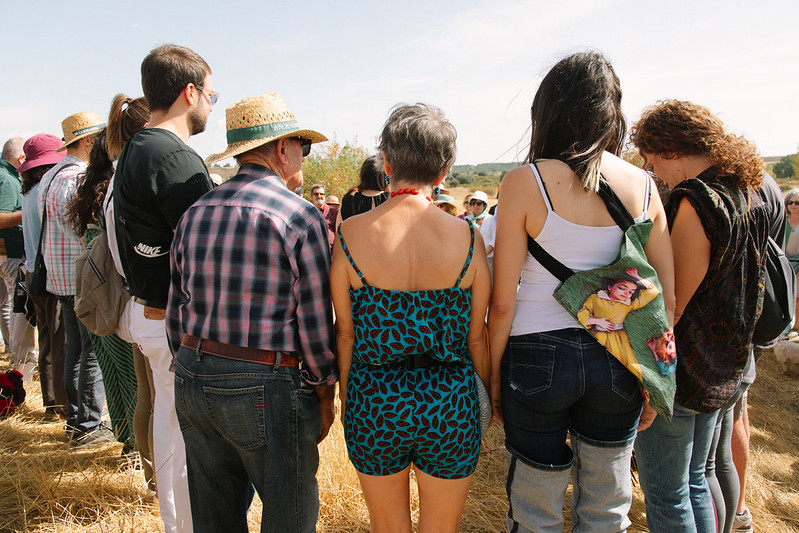
And this putting the body into the piece reached its most special moment when two of the guests, Carolina and Marta, invited us to join together touching each other in a big circle or when we made a big spiral holding hands to enter the piece. Solarities. These two moments have to do with the possibility of generating love between bodies and feelings that have never met. Elderly bodies, deaf bodies, children's bodies, urban bodies, territorially distant bodies or neighbouring bodies. Bodies that would never have met to love each other in this way if there had not been a struggle behind these acts. A struggle that the comitents have not finished, because in order to fight, one must first recognise what is really the deep desire that is submerged under the tangle of thoughts that prevent us from seeing it. And this is what we have done in Solar narrativesTo realise, to realise, to realise what we are and what we are already doing.
Daniela, another of the comitentes, said that in a way it doesn't matter if they build the macro-photovoltaic installation in La Sobarriba, because nothing will ever be the same for them or for the region. In a sense, the struggle has already been won. We have looked each other in the eye, full of anger or tears, and said to each other: “We are legitimate daughters of this land. This narrative is ours. Listen to us.